

A Second Renewal in About 13 Months, and What the County's Own Lawyer Told a Jury About the Brown Act: Tuesday, September 29th, 2026 Shasta County Agenda
 By Benjamin Nowain•September 29, 2026•8 min read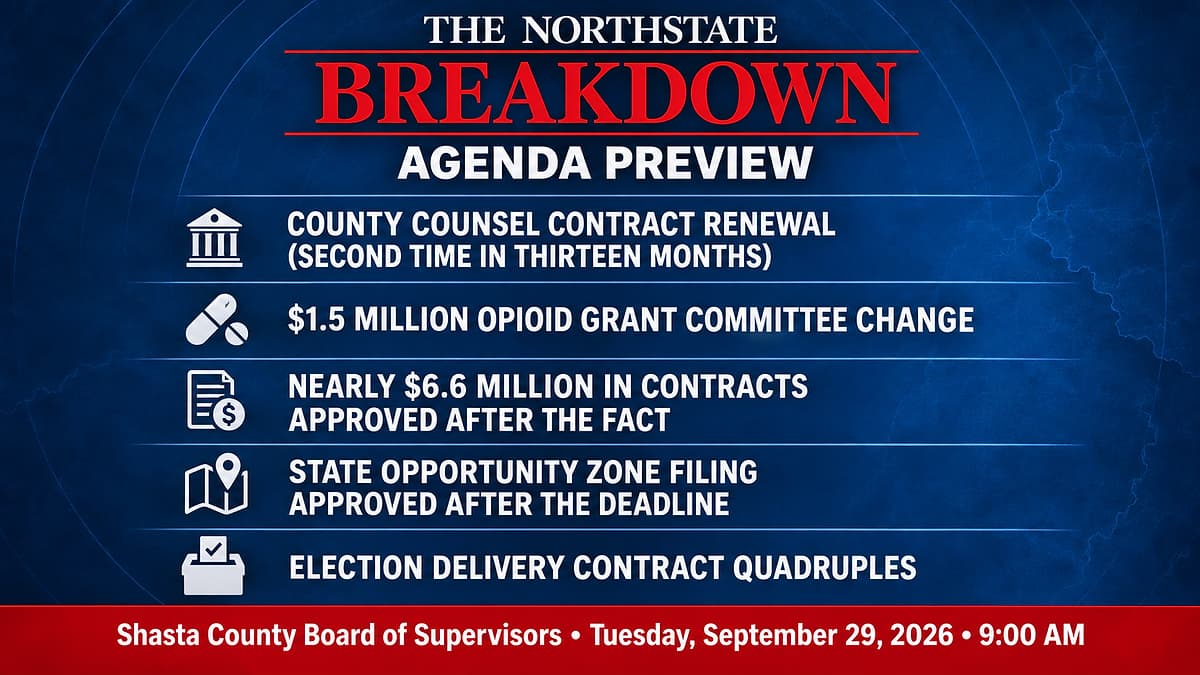
The Shasta County Board of Supervisors meets Tuesday, September 29, and most of what matters is on consent. The board is asked to renew County Counsel Joseph Larmour's employment contract for the second time in about 13 months, with no expiring term driving the timing. A staff report recommends swapping the review panel for a $1.5 million opioid-settlement grant program from the board to three staff members, a change spelled out in the body of the report but not in its title. Four health and social-service contracts, worth more than $6.6 million combined, are up for approval months after the services they pay for already started. And a state Opportunity Zone filing, on which the county checked "No" when asked whether the governing body had approved it, is up for the board's retroactive approval in September.
Two Renewals in About 13 Months
Item C10 asks the board to give Larmour a new four-year employment agreement starting September 30, at his current pay and benefits. What the staff report doesn't mention is that the board already renewed his contract once this cycle: on August 12, 2025, supervisors approved a new four-year term for Larmour running from August 13, 2025, carried 4-0 with Supervisor Allen Long abstaining, after Long's motion to put it off to the next meeting died for lack of a second. That term wouldn't have expired until roughly August 2029.
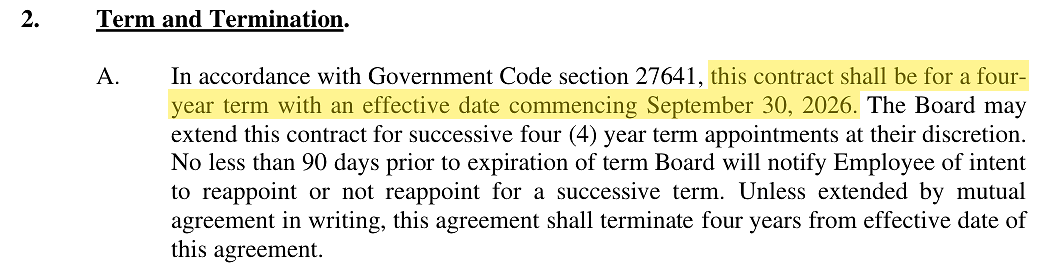
Tuesday's renewal would replace it with a term running to 2030, at $20,840 a month against 2025's $20,431, a roughly 2 percent difference consistent with the cost-of-living adjustment built into his contract; both staff reports simply say "no change in his current compensation." The severance terms are effectively unchanged: both the 2025 and 2026 agreements cap a lump-sum payout at 18 months of base salary, because the unexpired term under either contract already ran well past 18 months. What changes is the calendar, not the money.
Both renewals follow the same script: a closed-session evaluation, then a renewal. The 2025 evaluation ended with no reportable action, the standard public outcome for a closed session. The board's 2023 appointment of Larmour, and the 2025 renewal, were moved and seconded by Supervisors Kevin Crye and Chris Kelstrom. Crye lost the June primary to Erin Resner and leaves office in January. Kelstrom faces a November 3 runoff. Tuesday's staff report doesn't name who is asking for this renewal, describing it only as something "the Board majority wishes to consider."
The renewal also lands in the middle of a public dispute between Larmour's office and Registrar of Voters Clint Curtis, whom Larmour has told the board is in violation of state law for not destroying 2024 election ballots. Separately, the board censured Curtis on August 11 for substantiated findings of managerial misconduct following an investigation, unrelated to the ballots dispute. Nothing in the county's documents connects either dispute to the timing of the renewal.
What the County's Own Lawyer Told a Jury About the Brown Act
Larmour is the same official whose contract renewal is item C10, above. Sworn testimony he gave in a separate criminal trial last December offers a rare, on-the-record look at how he actually operates inside the meetings he is paid to advise.
Disclosure: that testimony comes from the public trial record of a Shasta County Superior Court criminal case in which this reporter's spouse was the defendant. Every quote below is Larmour's own sworn testimony, not this outlet's characterization or anyone's secondhand account of it.
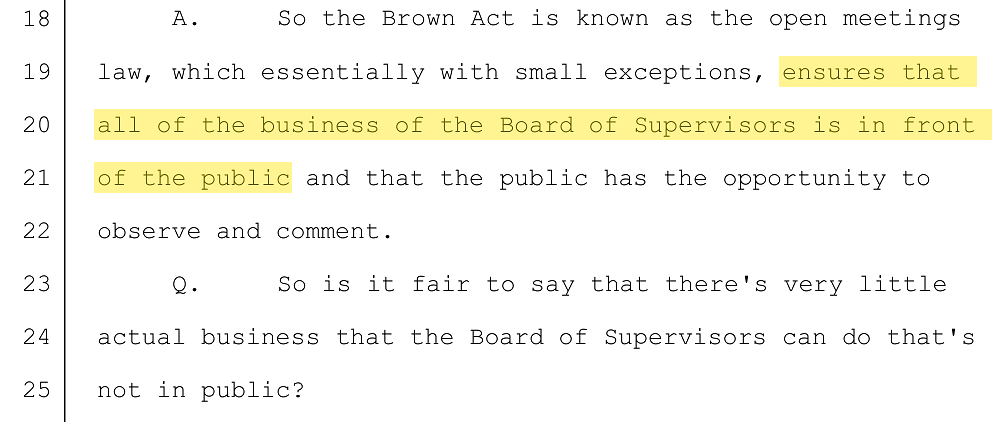
Larmour testified as a witness in that trial, People v. O'Connell-Nowain (Shasta County Superior Court case 25M-02227). Asked by a prosecutor to explain the Brown Act to the jury, he said it "is known as the open meetings law, which essentially with small exceptions, ensures that all of the business of the Board of Supervisors is in front of the public."
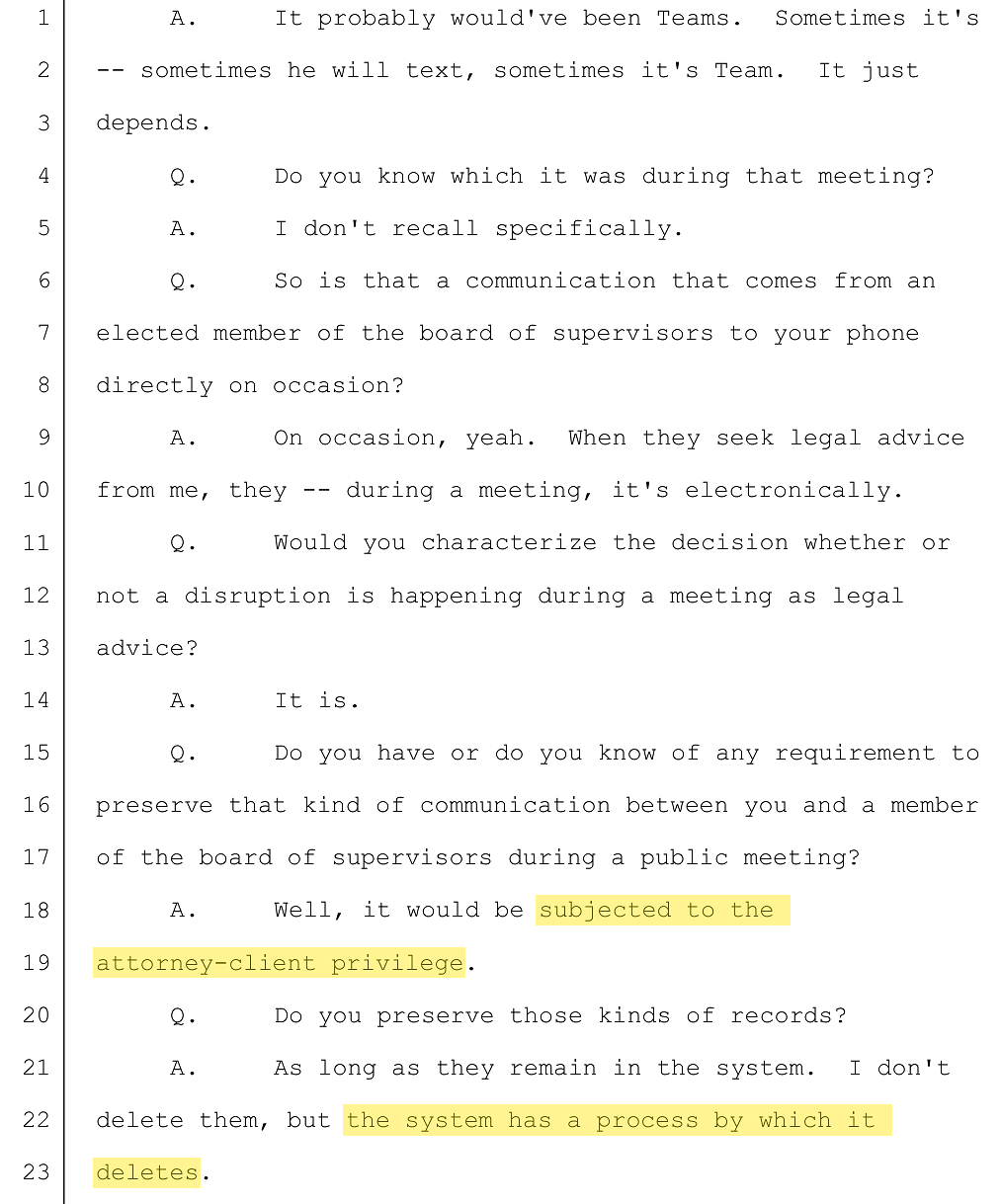
Later in his testimony, describing how he actually handles moments during a meeting, Larmour said that he and then-Chair Kevin Crye communicate through a look, then a text or a Microsoft Teams message, during open session. Asked how often, he said "every meeting." He testified that he treats those in-meeting messages, when they involve deciding how to handle a disruption, as legal advice and therefore attorney-client privileged, and that whether any particular message survives depends on the county's own systems: "I don't delete them, but the system has a process by which it deletes."
Defense counsel did press the point at trial, at one point arguing that it was actually Larmour making real-time decisions about the meeting, and asking on redirect whether the county was required to preserve that kind of communication. Whether privately routed, real-time guidance to the board's presiding officer during a public meeting, kept only until an automated process deletes it, fits inside the Brown Act's "small exceptions" is a legal question this piece isn't answering. What the record does show is that the county's own top attorney has told a jury under oath that he helps run its public meetings through a channel the public doesn't see and the county may not keep for long.
A Committee Swap on the Opioid Money
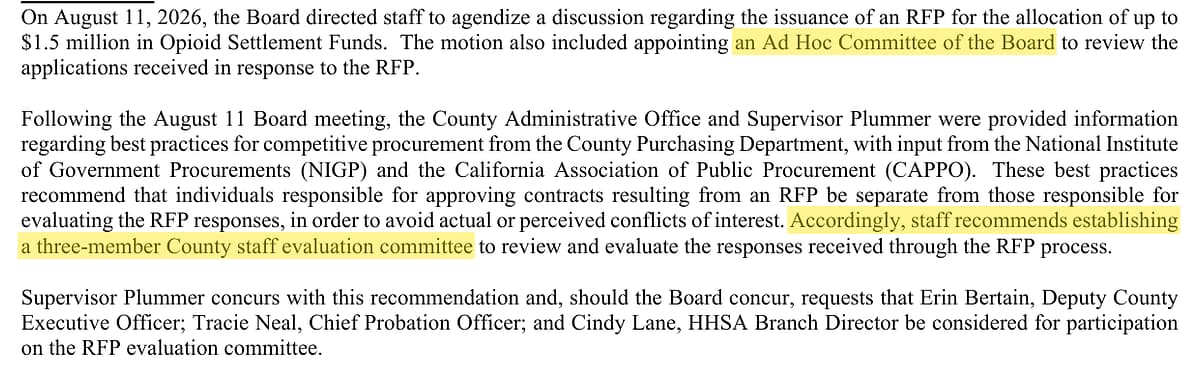
Item R4 asks the board to direct staff to open a $1.5 million request for proposals against the county's opioid-settlement fund. The agenda title, and the staff report's own recommendation line, describe appointing "an Ad Hoc Committee" to review the proposals. The body of the same report, which item sponsor Supervisor Matt Plummer says he agrees with, says something different: county purchasing staff advised separating the people who evaluate proposals from those who approve the resulting contracts, to avoid actual or perceived conflicts of interest, and recommends a three-person staff panel instead: Deputy CEO Erin Bertain, Chief Probation Officer Tracie Neal and HHSA Branch Director Cindy Lane. Neal is the only one of the three who heads a department that could plausibly apply for or partner on opioid-funded work; whether that possibility is addressed anywhere in the RFP's design isn't in the packet.
Worth noting, though it's long been on the public record and won't surprise regular meeting-watchers: Supervisor Kevin Crye is the board's own appointed representative to the Youth Violence Prevention Council of Shasta County, doing business as Youth Options Shasta, an unpaid seat listed in the county's 2025 committee assignments. Youth Options was one of the groups that presented to the board in 2025 as part of CORE, a coalition working on opioid-funded youth prevention, and the board approved a $250,000-a-year agreement with it in May 2025, on consent, unanimously, with no recusal recorded. It sits next to R4, which would route $1.5 million more of the same kind of money through a review process the new staff panel, not the board, would run.
More Than $6.6 Million, After the Fact
Four consent-calendar items ask the board to approve health and human-services contracts for work that, in every case, already started. Dragos Adrian Iordache, doing business as Care Horizons II, gets $800,000 added to a residential-care contract that dates to 2024; the amendment itself is retroactive to three months ago. Project 14:14, a Fresno youth residential mental-health treatment facility, gets a $200,000 agreement for an emergency court placement made 202 days before the vote. NVCSS gets a $3 million renewal, and Hill Country Community Clinic's CARE Center gets $2.62 million, both for work that began three months ago. Combined, that's more than $6.6 million in contract authority the board is being asked to approve after the fact.
Three of the four line up almost exactly with what county health staff themselves have called a "reasonable and typical" three-month lag for getting a contract signed. That makes this look less like an emergency and more like the county's normal way of doing business: renewals with end dates known years in advance routinely get approved after the new term has already begun. The pattern has already cost at least one vendor real money: Kings View, a mental-health provider that left the county this summer, told a local outlet contracting delays were part of why, though HHSA said it had paid all contracted eligible expenses through May.
Up for Approval After the State Deadline Already Passed
Item R1 asks the board to retroactively approve a state Opportunity Zone nomination form the county submitted on July 17, to meet a state deadline that had just been moved up. The form itself, filed that day, answered "No" to the question of whether the governing body had approved the recommendation. The board's first public direction on the matter came 11 days later, on July 28, and Tuesday's vote comes 74 days after the form was actually filed.
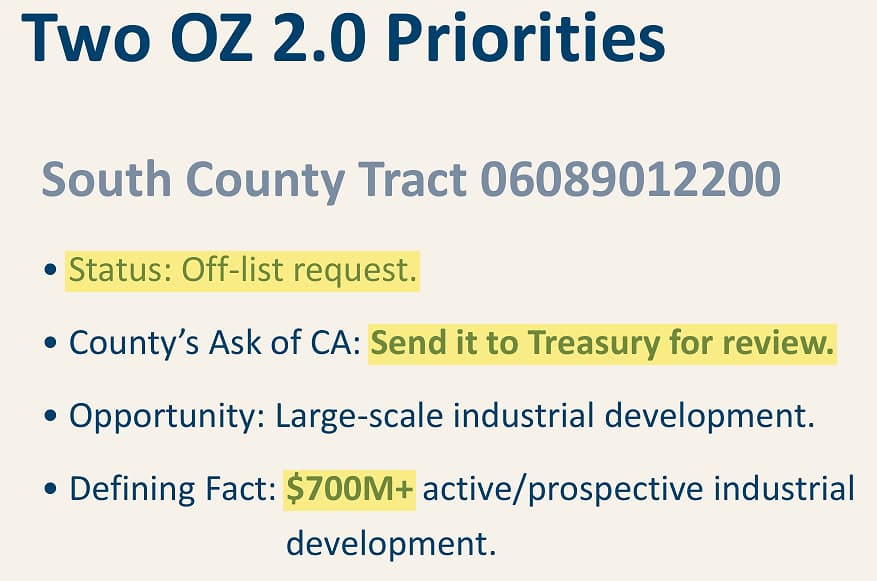
A slide deck the board is also being asked to "receive" Tuesday, prepared by the Shasta County Economic Development Corporation, describes a second census tract, in south county along Interstate 5, that isn't in the county's own staff report or recommendation at all. The deck labels it "County's Ask of CA: Send it to Treasury for review" and says the EDC "submitted the off-list request," after working with Shasta County, the City of Redding and other local partners, describing over $700 million in potential industrial development tied to it. Nothing in the packet says who at the county authorized that request, or whether anyone did.
Also on Tuesday
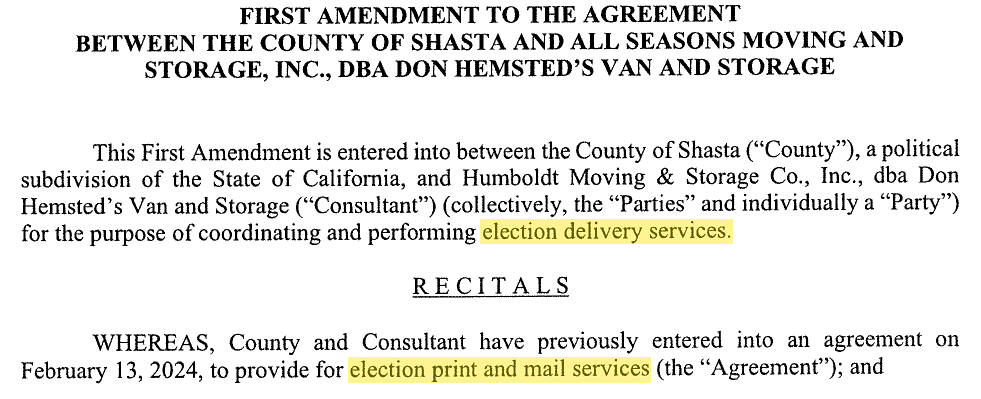
A mover's contract more than quadruples before the election (C3). A 2024 agreement with Humboldt Moving & Storage, doing business as Don Hemsted's, for delivering election materials gets its spending cap raised from $50,000 to $225,000 and its term extended to 2029, five weeks before the November 3 election. The amendment describes the original contract as covering "print and mail services"; Registrar Curtis's office says the work is delivery. We found no board approval of the original 2024 agreement in the local records we reviewed.
A department merger study finds nothing to recommend (R6, R7). A staff study, ordered by the county's top administrator, concludes there are "no readily apparent benefits" to merging Public Works and Resource Management, without offering cost, staffing or savings figures either way. The same day, the board goes into closed session to discuss appointing a permanent Public Works director; the interim director's 180-day limit runs out around the end of October.
A software renewal. The county renews its Esri mapping-software agreement at $288,720 over three years (C8).
A letter opposing a bill the governor already vetoed. The board is asked to send a letter formally opposing AB 1383, a public-pension bill Governor Newsom vetoed on September 20 (R2). The letter itself urges "continued consideration of the fiscal and policy impacts of similar changes" in any future legislation.
Promises not yet kept. A "Recovery First" substance-use policy the board directed a supervisor to develop on July 28 hasn't returned to the agenda in three meetings since. A proposed cap on nonprofit administrative costs, directed June 8, came back June 16 and was continued to a future date, and hasn't returned since. The county's records don't say why either is still pending.
What the Packet Doesn't Connect
None of Tuesday's items requires anything be wrong to be worth reading closely. A second renewal inside about 13 months for the same job, for a lawyer who has told a jury under oath that he helps run meetings through private messages the public doesn't see and the county doesn't keep for long. A grant-review committee the staff report recommends moving from the board to staff, spelled out in the report's body but not its title. More than $6.6 million up for approval for work county contractors performed before anyone signed off on it. None of it is hidden. All of it is in the packet for anyone who reads past the agenda title.
And that's the Agenda Preview.