

Forgiving a $300,000 Clinic Loan, and a Fire Plan That Doesn't Pick a Funding Source: Tuesday, October 13th, 2026 Shasta County Agenda
 By Benjamin Nowain•October 13, 2026•11 min read
The Shasta County Board of Supervisors meets Tuesday, October 13, at 9 AM, with 28 items on the agenda: 11 on the regular calendar and 17 on consent. Two stand out. The board is asked to approve an amendment that would forgive, over three years, a $300,000 loan to Hill Country Community Clinic that came due in 2022 and was never repaid; the agenda describes it as extending the due date, while the staff report calls it a write-off. Supervisors are also asked to adopt a long-range County Fire master plan that names sustainable funding as a critical issue without recommending a source. Below are the items most worth watching, followed by a rundown of the full agenda.
A $300,000 Loan, Forgiven in Three Steps
In April 2007 the county lent Hill Country Community Clinic $300,000 at zero percent interest, using federal Community Development Block Grant program money, secured by a deed of trust on the clinic's property. The loan came due in April 2022. According to the amendment itself, the county "did not declare Borrower in default, effectively deferring the due date," and "the Note has not been paid (partially or in full)."
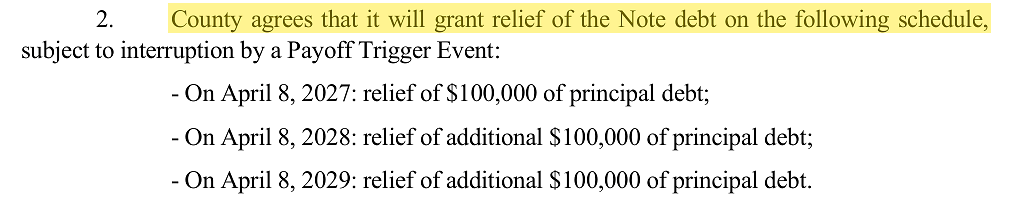
Item R8's agenda summary says the amendment "extends the due date" and "allows the County to reduce the unpaid principal." The amendment does more than that. It pushes repayment to April 8, 2029, then says the "County agrees that it will grant relief of the Note debt on the following schedule": $100,000 on April 8, 2027, another $100,000 on April 8, 2028, and the last $100,000 on April 8, 2029, the same day the remaining balance would come due. Unless the clinic transfers the property, stops occupying it, borrows against it without county consent, or falls out of compliance with federal program standards, the clinic never repays any of it.
The staff report is more direct than the agenda. It recommends that the loan "be written off" and says the county's housing agency, administrative office and auditor-controller "have concluded that the amounts in question should be relieved." If the board says no, it warns, the county would have to "pursue repayment of the outstanding loan or initiate foreclosure proceedings against a valued community partner and health provider, which is not in the best interest of the community." The report lists "No General Fund Impact," which is accurate: repaid loans of this kind return to a fund the report says is "used in perpetuity for housing programs." If the board approves, that $300,000 won't arrive.
Staff cites a "CDBG Master Guidelines" document as giving counties discretion to convert loans like this one to grants. We did not find a rule, in the federal regulations or the state program-income guidance we reviewed, that either allows or forbids it, and the packet doesn't say whether the California Department of Housing and Community Development was consulted.
The county has a stronger argument than the one the packet makes: this loan may never have been realistically collectible. It sits second, behind a bond loan on the same property that was refinanced at $2.55 million plus a $90,304 premium, and foreclosing on a community health clinic would be its own problem. The clinic reported about $18.8 million in revenue and $28 million in total assets in its IRS filing for 2024. Hill Country CEO Jo Campbell is scheduled to present before the vote.
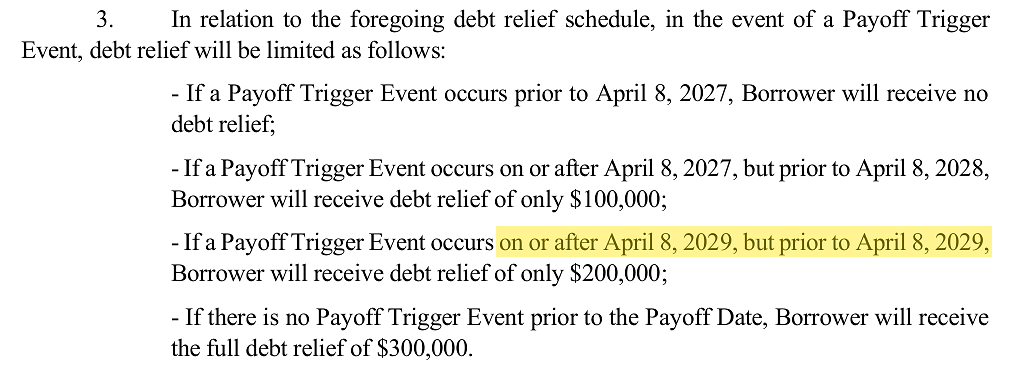
One more detail. The amendment was signed September 22 by Campbell, the county's risk manager and a deputy county counsel, so it reaches the board already signed by everyone except the chair and the clerk who attests. Its third paragraph includes a window that can't exist: "on or after April 8, 2029, but prior to April 8, 2029." The intended start date was almost certainly 2028. Whether a corrected version will be substituted before the vote isn't in the packet.
A Fire Plan That Doesn't Say How to Pay
Item R4 asks the board to "adopt" a nearly 300-page County Fire Long-Range Master Plan and Community Risk Assessment prepared by consultant AP Triton, and to "consider providing direction." The staff report says there is "no additional General Fund Impact as a result of receiving the presentation or adopting" the plan, and flags a "Future General Fund Impact" that depends on the board's later direction.
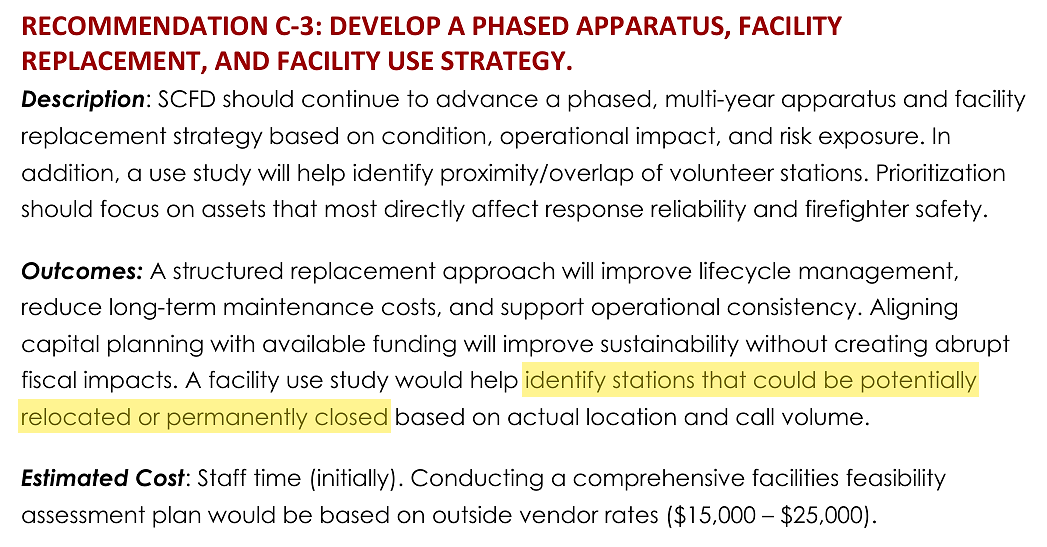
The plan names "sustainable long-term funding" as a critical issue and says more career staffing could require "increased taxes or reallocation of public funds," but it does not recommend or price a funding source. Its largest priced item is one $172,942-a-year training captain. It also recommends a facility study that "would help identify stations that could be potentially relocated or permanently closed."
The money picture comes from the county's own budget documents. The plan's financial review stops at fiscal 2024-25, when CAL FIRE, which staffs County Fire under contract, was paid $7.56 million. The board has since approved ceilings of $11.4 million for 2025-26 and $11.28 million for 2026-27. Five years ago the ceiling was about $5 million.
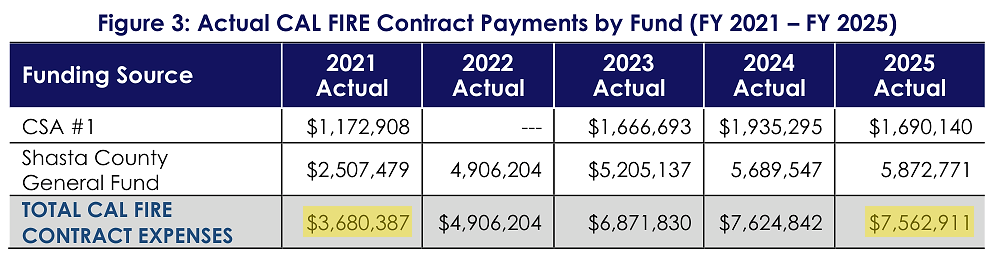
This year's budget puts $6,875,762 in general fund money toward County Fire. The county administrator's budget narrative ties recently added staffing to Zogg Fire settlement dollars, and warns: "Although the recently mandated increased staffing is covered in the short term by outside revenue, in the future, these costs will fall to the General Fund, which cannot sustain these costs long term." At a June budget hearing, Fire Warden Sean O'Hara's slides projected a shortfall of about $800,000 in fiscal 2029-30, growing to $4.5 million to $5 million in 2030-31.
On the same agenda's consent calendar, the Shasta Lake Fire Protection District, a separate district, asks for a $250,000 dry-period loan from the county because "salaries and benefits ... exceeded available funds." The staff report says the district "will work to right size their workforce."

Asked to Approve After the Fact
Several consent items ask the board to approve contracts for work that has already started or finished. That's a routine practice in Shasta County, and some cases have good reasons, but it means the board's vote often arrives after the money is committed.
Three Health and Human Services contracts start 128, 104 and 83 days before Tuesday's vote (C4, C5, C6). The newest, a $200,000 agreement with Mindful Growth Foundation, a Los Angeles youth residential treatment provider making its first appearance on a board agenda, follows an emergency placement by a court; the staff report says "services have already been provided to the youth prior to the County having an active agreement in place." It's the fifth contract of its kind, for out-of-county youth residential treatment after a court placement, to reach the board after the fact in four meetings.

A fourth amendment to DLR Group's design contract for a jail transportation and courtroom project (C10) takes effect August 1, and the staff report says "the work has already been conducted. Without the amendment, the consultant will not be compensated." It adds $12,700 for redesign after jail staff identified safety and operational concerns with the new security system. Over four amendments the contract has grown about 65 percent, from $1,038,700 in 2023 to $1,712,836. When the board first awarded it, Supervisor Mary Rickert, the lone no vote, said the county should follow its normal competitive procurement process, according to the minutes.
The county's Kobylanski autopsy contract (C16) goes from $200,000 to $230,000, retroactive to July 1. It was $100,000 in February 2025, making two retroactive increases totaling 130 percent in 20 months. The staff report gives no case counts, rates or spending to date.
Jones Valley's Water System Ran Dry
The clearest case for acting first is item C14. The intake pump on Shasta Lake that supplies County Service Area 6 in Jones Valley, a water system serving about 500 households, failed on September 28. By September 30 its storage ran dry and "large portions of the community" had no municipal water until October 4, according to the staff report. The system "lacks any alternate source of supply for drinking water and fire suppression."

The board is asked, by four-fifths vote, to declare an emergency effective September 28, waive bidding, and authorize the Public Works director to "enter into and sign contracts required by the emergency." It would appropriate $250,000 from the service area's retained earnings plus a general fund loan of up to $250,000. Temporary pumping cost about $65,000 to mobilize and runs about $17,000 a month in rentals. The permanent repair is "expected to be in excess of $4,000,000," and "talks are ongoing with the State" for up to $1 million in emergency drinking-water funds. The packet doesn't name the emergency contractors. The board must review the emergency every 14 days, so this item should return.
Who Approves Training for New Supervisors
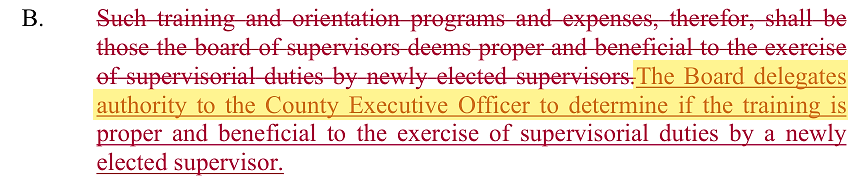
Item R10 introduces an ordinance changing how supervisors-elect get approval for training before they take office. Today the code covers training "the board of supervisors deems proper and beneficial," approved by the board. The amendment would read "The Board delegates authority to the County Executive Officer to determine if the training is proper and beneficial," with requests going to the CEO and Clerk of the Board. It sets no dollar cap and no reporting back to the board; requests stay subject to the county's existing expense-reimbursement rules. The staff report doesn't say who asked for the change. Tuesday is introduction only; the redline in the packet is dated for adoption October 27.
The board has used this vote before. In September 2024 it put off then-supervisors-elect Allen Long's and Matt Plummer's training requests for a week on a 4-1 vote led by Crye and Kelstrom, then approved them unanimously; according to the minutes, Crye said he wanted to arrange a local training so all incoming supervisors could have the same training. The ordinance would govern requests made after it takes effect, including any from Supervisor-Elect Erin Resner and from the District 5 winner if Kelstrom, the current chair, loses his November 3 runoff to Anderson council member Mike Gallagher.
Recovery First Returns
Supervisor Matt Plummer's "Recovery First" proposal, which the board directed him to develop on July 28, returns as item R9, a discussion item asking for direction. The draft resolution, already printed "adopted this 13th day of October," would make "long-term recovery" the guiding objective of county-funded substance-use programs and require a "Recovery Impact Statement" on staff reports for new or modified behavioral health, public health, homelessness and substance-use programs. New or materially changed programs that the administering department judges "materially inconsistent" with it would need board approval at a public meeting first. A savings clause says nothing in it requires breaking state or federal law, a court order, or a grant condition.
The Full Agenda
Here is every item on Tuesday's agenda, in the order the board takes them up.
Regular Calendar
R1. Employee of the Month. A resolution recognizing Ashleigh Roller, an investigative technician with the Sheriff's Office.
R2. Breast Cancer Awareness Month. A proclamation for October, sponsored by Supervisor Chris Kelstrom.
R3. Red Ribbon Week. A proclamation for October 23 to 31, sponsored by Supervisor Allen Long.
R4. County Fire master plan. A presentation from AP Triton and adoption of the plan. Covered above.
R5. National 4-H Week. A Farm Advisor presentation on 4-H leadership and a proclamation for October 4 to 10, a week that ended before Tuesday's meeting.
R6. Restaurant plan-review fees. An Environmental Health presentation on plan-review fees for new food facilities, following a September 29 motion by Kelstrom. Staff's table shows the fees recover about $39,400 a year from roughly 60 reviews, and under county policy 2-202, staff asks what would replace that money if the fees are waived.
R7. CEO update and supervisors' reports. No vote. The item allows action on legislation but names no bill.
R8. Hill Country clinic loan. A presentation from the clinic's CEO and the loan amendment. Covered above.
R9. "Recovery First." Covered above.
R10. Training for supervisors-elect. Introduction of the ordinance. Covered above.
R11. Closed session. Supervisors meet privately about "one potential case" of anticipated litigation. The agenda doesn't say who or what it involves.
Consent Calendar
Consent items are usually approved together in a single vote unless a supervisor pulls one for discussion.
C1. Dry-period loans. $250,000 to the Shasta Lake Fire Protection District and $87,481 to the Burney Cemetery District, both repaid from future property taxes. The Burney staff report mistakenly says its loan is repaid from taxes due to the Shasta Lake district.
C2. Library advisory committee. Reappoints Raymond Van Diest, a current member and the only applicant, to a four-year term starting December 1.
C3. Real estate fraud report. The District Attorney's 2025-26 report: 17 complaints, 4 cases filed, 5 convictions and $250,735.82 in restitution ordered. The unit's expenses for the year were $55,554.
C4, C5, C6. Retroactive health contracts. A Health Catalyst software license for health-privacy risk assessments (C4), a renewal with EA Family Services for youth residential mental health care (C5), and the Mindful Growth Foundation agreement (C6). Covered above.
C7. Roadway Safety Action Plan. The $130,000 "Vision Zero" plan already says the commitment "was made by a Resolution ... on October 13, 2026," and its pages are dated October 14. It puts no dollar figures on its projects, rating costs only from $ to $$$.
C8. Big Bend Road slide. A $7,400 right-of-entry and easement agreement with CAL FIRE, the state Department of General Services and Shasta Land Trust so the county can repair a road slide that dates to 2017.
C9. Materials testing. On-call testing contracts with CGI Technical Services and Pavement Engineering, up to $220,000 each through 2029.
C10. Jail design contract. The DLR Group amendment covered above, plus $955,000 re-budgeted from a jail reserve (see C13).
C11. French Gulch water. $115,000 from County Service Area 11's retained earnings to repair an inoperable filter at its water treatment plant and for cross-connection inspections.
C12. County vehicles. A vehicle price list for the rest of the fiscal year, bids awarded to Crown Motors, Lithia Toyota Redding and One Nation Distribution LLC, and $114,000 more for replacement vehicles.
C13. Sheriff's emergency operations center. Budget amendments for the center's expansion. Together with C10, the county draws $1,222,473 from a reserve that, according to 2025 board minutes, Deputy CEO Erin Bertain described as set aside "with the intent to be used for a new or expanded jail facility"; in the same remarks she said she would support using it for the old courthouse demolition. Both items re-budget money the county did not spend last year, and for this project the total planned draw on the reserve is falling, from $1,193,948 to $876,533. Neither item says how much is left in the reserve.
C14. Jones Valley water emergency. Covered above.
C15. Air district agreement. An open-ended agreement under which the county provides facilities, administrative, legal and other support to the Shasta County Air Quality Management District. Crye signs for the district as chair of its board.
C16. Autopsy contract. Covered above.
C17. Sheriff's boat. Accepts a $54,284 state Division of Boating and Waterways grant to re-power Boat #15.
What to Watch
The R8 vote is the county deciding, in writing, that a loan it never collected won't be collected, under an agenda line that calls it an extension. The fire plan asks the board to adopt a direction without a price, while the budget documents show the bill growing. And several consent items ask the board to approve work that has already been done. All of it is in the packet for anyone who reads past the agenda title.
And that's the Agenda Preview.