

New Court Filing Raises Questions About How Measure B Made It Onto the June Ballot
 By Benjamin Nowain•March 13, 2026•7 min read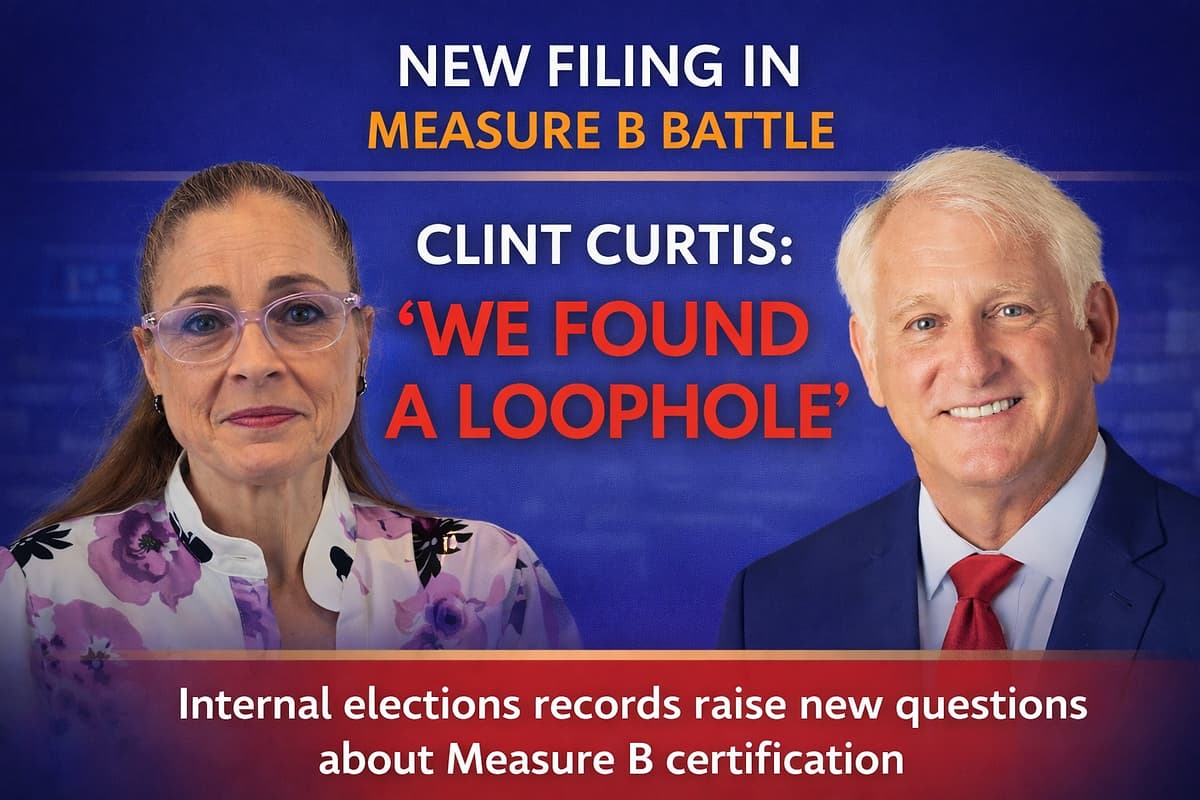
Internal Elections Office Records Raise New Questions About How a Contested Petition Qualified
REDDING, Calif. — A Redding woman has filed a 172-page supplemental memorandum in Shasta County Superior Court today alleging that Measure B — the "Local Election Transparency and Security Reform" initiative set to appear on the June 2026 ballot — was improperly certified despite questions about whether its own statistical signature validation was conducted correctly.
The filing, submitted by Jennifer Katske in the pending writ of mandate case (Case No. 209919), centers on four internal documents obtained from the Shasta County Elections Office through a Public Records Act request received late on March 5. Those records, according to the filing, tell a story that the public has not previously seen: a petition that an internal staff email described as having failed its required signature test in September, followed by a private email from the county's own Registrar of Voters telling an initiative proponent that he had found a way to make it qualify anyway.
The hearing is scheduled for March 25, 2026, before Shasta County Superior Court Judge Benjamin Hanna, Dept. 64, at 8:30 a.m. The ballot printing deadline is April 2 — meaning the court's decision will effectively determine whether the measure appears on the June ballot at all.
Background: What Measure B Would Do
Measure B would amend the Shasta County Charter to require single-day in-person voting, hand-counting of ballots at precincts, photo ID requirements, limitations on absentee ballots, and voter rolls maintained on a computer disconnected from the California state system. OnElection law experts and state officials have noted that several of these provisions would conflict with existing state and federal law. A similar but narrower measure passed by voters in Huntington Beach last fall was subsequently struck down by the California Attorney General.
The measure was circulated beginning in March 2025 after proponents — Laura Hobbs, Deidre Holliday, Kari Chilson, Jim Burnett and Richard Gallardo — filed a Notice of Intent with the Shasta County Deputy Clerk. That notice explicitly described the effort as a "charter amendment for election transparency reform." The distinction matters enormously under California law, because charter amendments carry a significantly higher signature threshold than general ordinances.
Notable among the proponents: Hobbs is an employee of the Shasta County Elections Office itself. The editors of Shasta Unfiltered, a local outlet that has covered Measure B favorably and published footage of Registrar Curtis's post-hearing press conference, are also listed proponents of the measure.
The Signature Threshold: Two Different Standards
Under California law, the required signatures depend on what kind of measure is being circulated.
For a charter amendment — which is what proponents told every signer they were signing — the threshold is 10 percent of registered voters. With 115,735 registered voters in Shasta County at the time, that required 11,573 valid signatures. Cal. Const. Art. XI §3(b)
For a general ordinance — a fundamentally different and less powerful legal instrument — the threshold is 10 percent of votes cast for governor in the most recent election. Using 2022 gubernatorial turnout in Shasta County, that figure is 6,852 valid signatures. Elections Code §9116 (§9116 has been repealed; same formula now in §9118)
On Sept. 16, 2025, proponents submitted 10,110 raw signatures. Before any counting, the petition fell short of the charter amendment requirement on its face.
What the Internal Records Show
What happened next is at the center of Katske's filing.
California law requires that when more than 500 signatures are submitted for an initiative, the elections office conduct a statistical random sample of at least 500 signatures. If fewer than 95 percent of the sampled signatures are valid, the petition automatically fails. Elections Code §9115(c)(2)
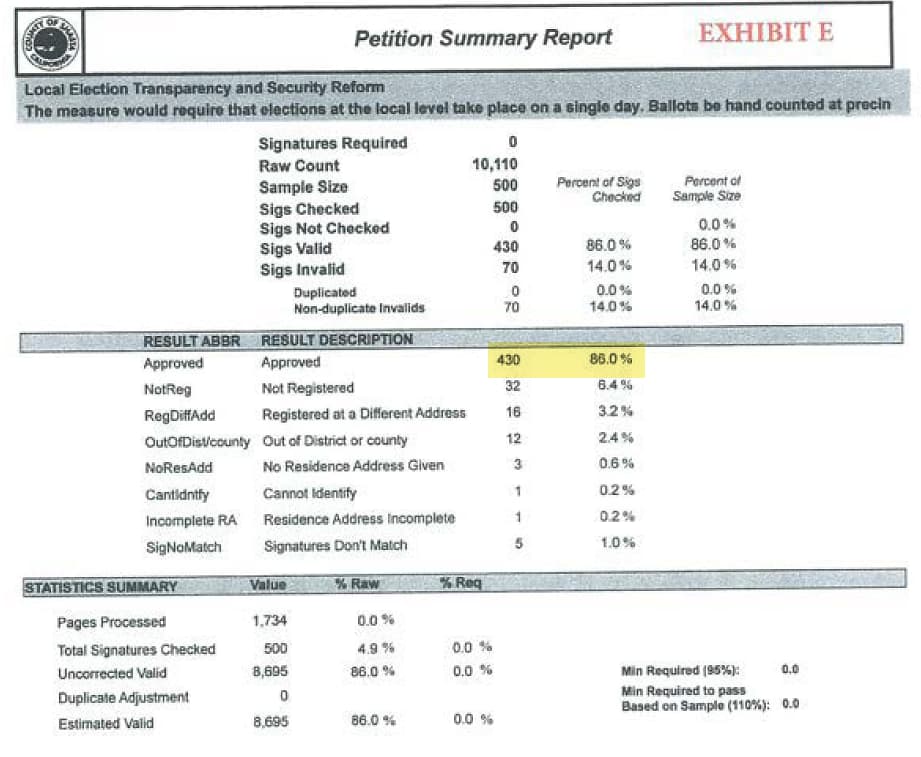
The Elections Office sampled 500 signatures. Of those, 430 were found valid — an 86 percent validity rate. Applying the statistical formula to the full submission, the projected total of valid signatures came to 8,695.
On Sept. 24, 2025, Supervising Staff Services Analyst Thomas "Tommy" Talkington sent an internal email to Registrar Clint Curtis and senior elections staff (Exhibit B). The filing quotes the email directly:
"The petition submitted for: Local Election Transparency and Security Reform, has failed to meet the 95% minimum qualified signatures to pass the statistical sampling as required by Election Code 9115."
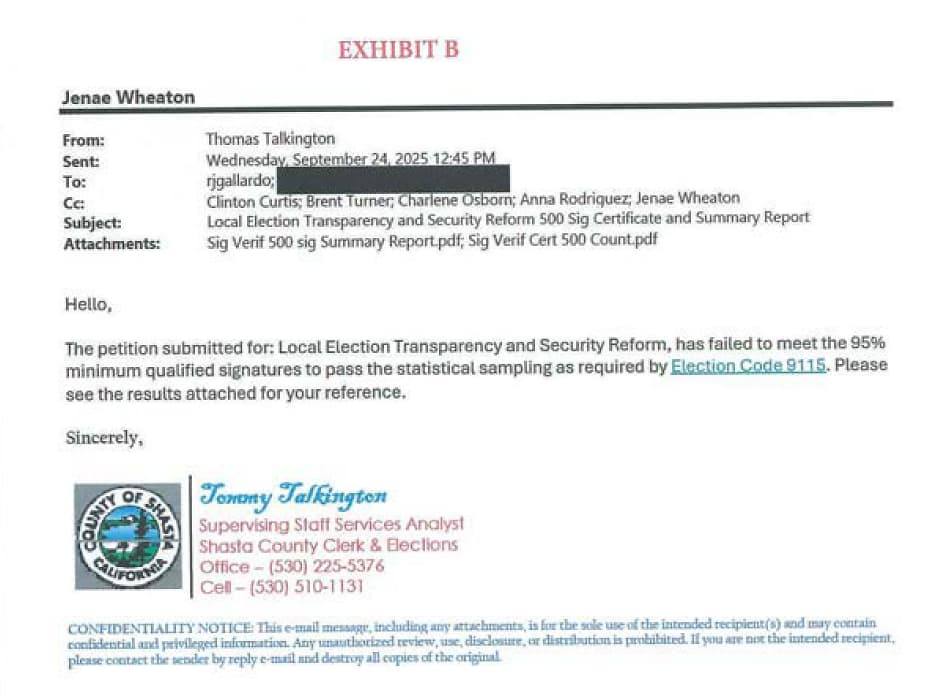
According to Katske's filing, that email should have ended the process. Elections Code §9115(c)(2) states that once a petition fails the statistical sample, the county elections official "shall certify the petition to be insufficient." The filing argues the word "shall" leaves no room for discretion.
But that is not what happened.
"We Found a Loophole"
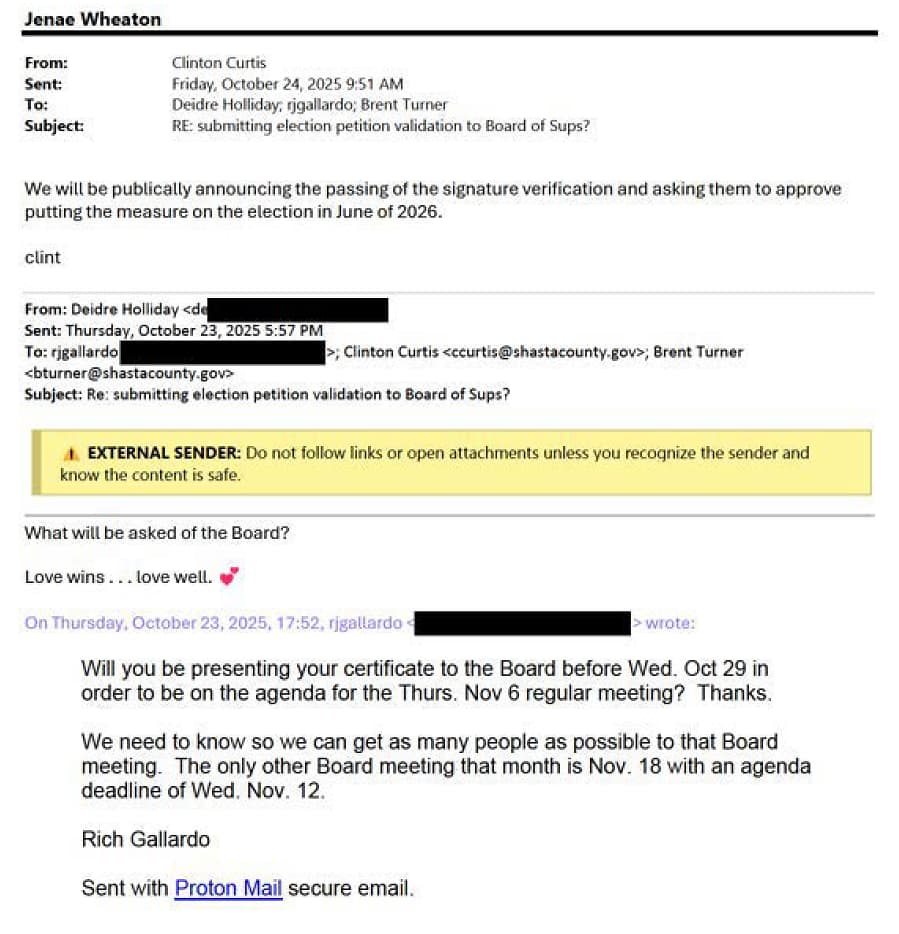
On the morning of Sunday, Oct. 12, 2025 — more than two weeks after Talkington's email — Registrar Curtis sent an email from his county email address to an initiative proponent (Exhibit C). The filing quotes it in full:
"We found a loophole that should be able to get the Charter Amendment passed. We have started the process but the SOS office has a formula where you can apply a particular equation to the survey and then certify the results based on that equation. There math is a little odd but once I clear it with the county legal department, I should be able to certify the results as you having 149% of the signatures you need to pass."
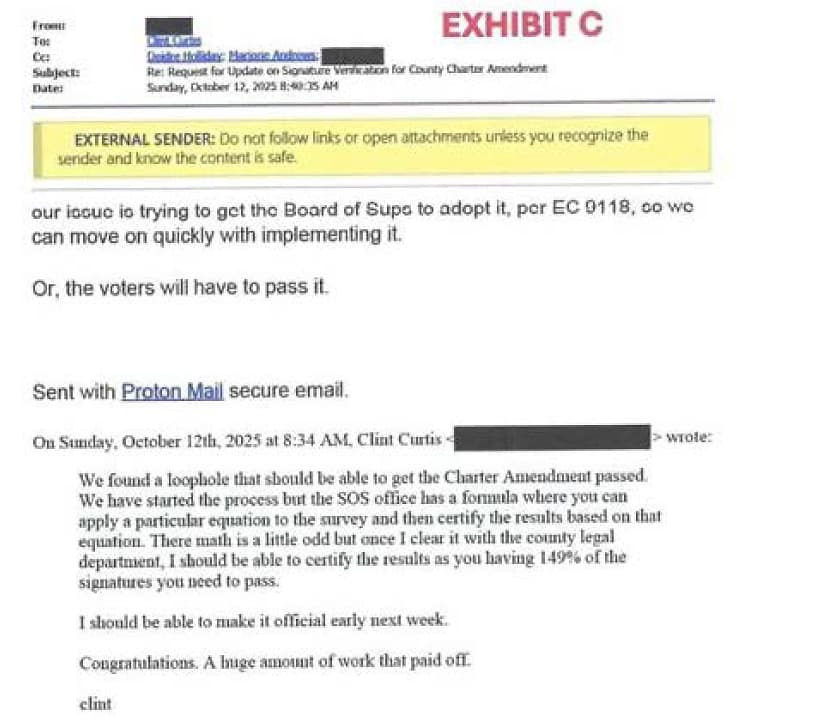
The 149 percent figure is not a mystery. It is the result of dividing the 8,695 projected valid signatures by the general ordinance threshold of 6,852 — rather than the charter amendment threshold of 11,573 that the petition was circulated under. Using the lower bar, 8,695 clears the threshold. Using the charter amendment threshold under which the petition was circulated, it falls 2,878 signatures short.
Curtis noted in the email that he still needed to "clear it with the county legal department."
On Oct. 24, 2025, Curtis publicly reported the 8,695 verified signature figure and certified the initiative using the general ordinance threshold. The measure was placed on the June 2, 2026, ballot by the Board of Supervisors on Nov. 6, 2025.
The Certification That Preceded the Internal Report
One of the most striking pieces of evidence in the filing is a date discrepancy on the official Signature Verification Certificate itself (Exhibit D).
The certificate — signed by Curtis via Deputy Clerk Charlene Osborn — is dated Sept. 22, 2025. Talkington's internal email reporting that the petition had not met the statistical threshold is dated Sept. 24, 2025.
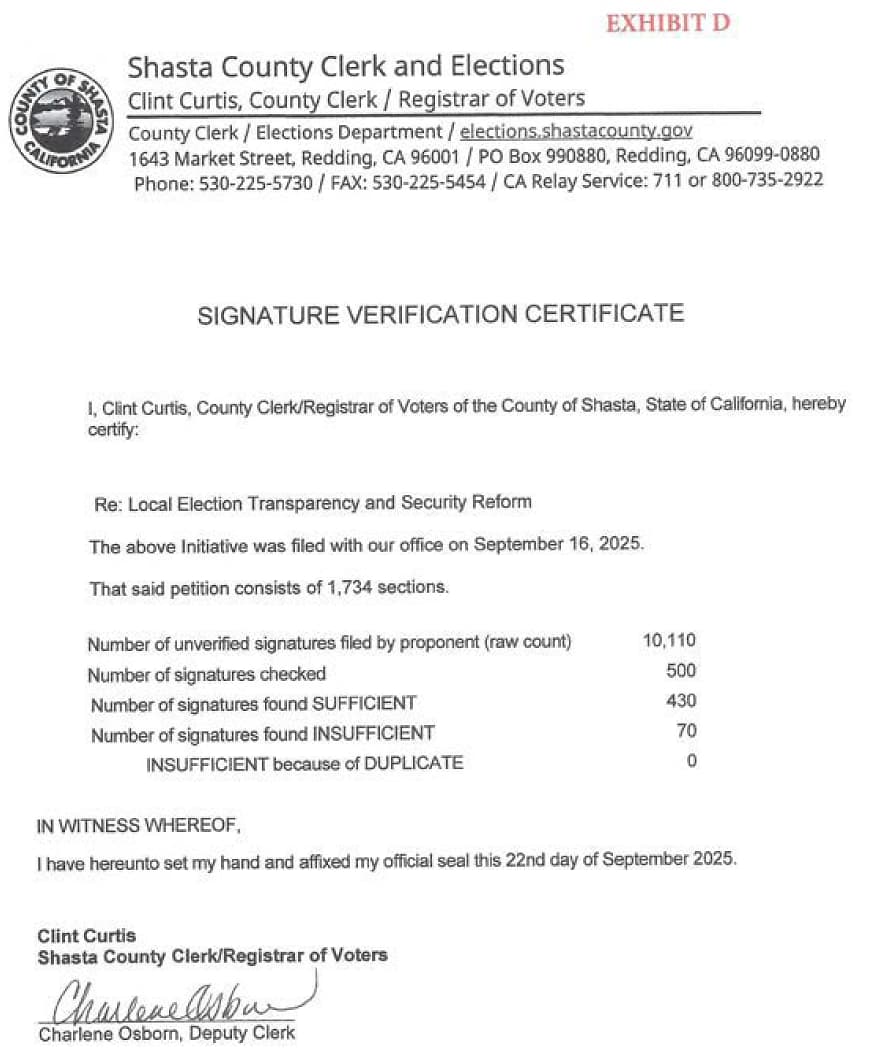
In other words, the official certification was signed two days before the staff's internal finding that the petition had not met the statistical threshold. The filing presents this sequence as evidence that the certification process was out of order — that a certification document exists that predates the underlying analysis it was supposed to certify.
The Legal Argument: A "Fatal Dilemma"
Katske's filing frames the measure's predicament as a fatal legal dilemma from which there is no clean exit.
If it is a charter amendment — as proponents described it to every person who signed the petition — then it needed 11,573 valid signatures and received an estimated 8,695, according to the filing. Katske argues that shortfall means the petition did not qualify. Cal. Const. Art. XI §3(b)
If it is a general ordinance — as Curtis certified it — then proponents made a material misrepresentation to every signer, because they were told they were signing a charter amendment. The filing cites San Bernardino County Fire Protection Dist. v. Page (2024) for the proposition that material misrepresentation to signatories can void an initiative regardless of how many signatures were gathered.
The filing further argues that Curtis exceeded his authority as a ministerial officer. Once the 86 percent validity rate was confirmed, Elections Code §9115(c)(2) required him to certify the petition insufficient, Katske argues — and that he had no legal authority to apply a different threshold to make it qualify.
Katske is asking the court to enjoin the measure's placement on the June ballot pending a full investigation. She has also delivered the evidence to the California Secretary of State, the Attorney General and the Department of Justice.
Where Things Stand in Court
This case has had a complicated procedural history even before today's filing.
Katske originally filed her challenge on Feb. 17, initially under the pseudonym "Jane Doe," citing a documented climate of harassment and intimidation in Shasta County toward those who challenge those in power. Judge Hanna ordered her to refile under her real name, which she did.
She later published a statement, writing:
"I brought this case against the Shasta County Board of Supervisors and the Registrar of Voters for one reason, and one reason only: the law."
On Feb. 25, Hanna issued a temporary restraining order pausing ballot preparations. That order was appealed by initiative proponents — including Elections Office employee Hobbs — who intervened in the case. On March 6, the Third Appellate District (Judges Elena J. Duarte, Shama Mesiwala and Aimee A. Feinberg) paused Hanna's ruling, allowing ballot preparations to resume. The court noted its order "expresses no opinion on the validity of the initiative in question."
As reported by Shasta Scout's Annelise Pierce, the Elections Office has also released a deadline of March 13 at 5 p.m. for written arguments for and against Measure B for the voter pamphlet. The county has already missed the March 6 deadline to request a fiscal impact analysis from the county auditor.
Meanwhile, Curtis has publicly and aggressively defended the measure. Following the Feb. 26 court hearing, Curtis held an impromptu press conference — footage of which was published by Shasta Unfiltered, whose editors are themselves proponents of the measure — in which he accused County Counsel Joseph Larmour of ethical violations, threatened to file a bar complaint against him and suggested the initiative's supporters could recall Judge Hanna.
Curtis Said:
"I think the people get to decide. When judges decide, when people hiding in the shadows decide, I think it's a bad thing."
This footage was taken earlier in the courthouse.
Today's supplemental filing introduces evidence that Curtis may have had private communications with initiative proponents while acting in his official capacity as Registrar — communications that have not previously been part of the public record.
What Happens Next
The March 25 hearing before Judge Hanna will be the critical juncture. If the court does not act before April 2, the ballot goes to the printer and Measure B appears before Shasta County voters on June 2, 2026.
Whether or not the measure is ultimately enjoined, today's filing places on the public record a set of internal documents — a failure email, a "loophole" email, a back-dated certification and a petition summary — that describe a certification process that diverged sharply from what California law appears to require.
The filing is 172 pages, including the full text of the California Public Records Act-obtained documents as exhibits. It was also the subject of a press release sent to media today by Dolores Lucero of Shasta County Watchdog, a civic oversight organization.
It can be read in full here - Katske v. Shasta County: Supplemental Memorandum & Exhibits
.