

Shasta County Board Meets Tuesday 5-4-2026 — And the Curtis Crisis Is Still the Story
 By Benjamin Nowain•May 5, 2026•16 min read
The censure is on hold, the agenda names him in closed session, and four election-spending contracts await board approval. Here is what to watch at the May 5 meeting.
This is an agenda preview for the Shasta County Board of Supervisors regular meeting on Tuesday, May 5, 2026.
The Shasta County Board of Supervisors meets Tuesday morning for its first regular session since a deeply divided special meeting ended without formal action against County Clerk and Registrar of Voters Clint Curtis — but with a public investigation report documenting a pattern of workplace misconduct and a litigation landscape that has grown significantly more complicated in the days since.
The board voted 3-2 on April 28 to delay a censure vote until after the June 2 primary. That decision did not resolve anything. It punted the most contentious question in county government — what to do about the man who will administer that same primary — less than five weeks out from Election Day.
Tuesday's regular meeting won't feature a censure vote. The board majority made that clear. But the published agenda contains something almost as significant: a closed session item that explicitly names Curtis as the source of anticipated litigation against the county and county officials. Separately, four election-related spending items on the consent calendar — all submitted with Curtis listed as department contact — ask the board to commit millions of dollars to election system infrastructure, on contracts that extend years into the future.
CLOSED SESSION, ITEM R12 — CURTIS IS NAMED


The most consequential language on the entire May 5 agenda appears at the end, in the closed session announcement for Item R12.
Under the heading "Conference with Legal Counsel — Anticipated Litigation" and citing Government Code Section 54956.9(d)(2), the agenda states:
"Significant Exposure to Litigation: One potential case. The significant exposure to litigation arises from a threat of litigation and actions by the Shasta County Clerk and Registrar of Voters, Clint Curtis, against Shasta County and County Officials."
This is a specific, official disclosure. State law requires that when a closed session is convened to discuss anticipated litigation, the agency must state on the agenda whether the exposure is significant and identify its source where required. The May 5 agenda does exactly that: it names Curtis by title and states that the threat is coming from him, directed at the county and its officials.
The agenda does not specify whether Curtis has filed suit, announced a specific claim, or issued a formal demand. What it establishes is that county counsel believes the threat is significant enough to require a closed session briefing with the board.
This is not entirely surprising given the public record — and a pattern that goes back further than the past two weeks.
Outside the courtroom on February 26, 2026, following the first hearing in Jennifer Katske v. Curtis et al. — a lawsuit challenging Measure B's placement on the ballot, filed against Curtis in his official capacity as Registrar of Voters and against the Board of Supervisors — Curtis was asked by KRCR reporter Mike Mangas what he would do if the county didn't appoint an attorney to defend the measure.
Curtis explicitly stated:
"I will hire one personally and I will sue the county to pay for it. This is important enough to go to war for."
He also stated during the same exchange that he intended to file a bar complaint against County Counsel Joeseph Larmour, alleging that Larmour had improperly advised county officials regarding Measure B, then represented the county on the matter — conduct Curtis described as "completely illegal" and "unethical."
More recently: Curtis told Shasta Unfiltered on April 26 that he intends to file a defamation lawsuit against one or more elections office employees who filed complaints with county HR. At the April 28 special meeting, he said publicly that he was "unafraid to take Oppenheimer to court." Specific claims, defendants, and procedural status of any lawsuit Curtis may have filed have not been confirmed through court records reviewed for this article.
The R12 item is listed as one potential case. What happens after closed session is what matters publicly: county counsel will report any action taken in open session. That report is the only public window into how the board is responding to the threat.
CLOSED SESSION, ITEM R11 — EXISTING LITIGATION
Item R10, is a real property negotiation involving parcels at 3905 Shasta Dam Boulevard. County negotiators are CEO David Rickert and Senior Administrative Analyst Bryce Ritchie.
Separate from R12, Item R11 lists three existing cases for legal counsel conference under Government Code Section 54956.9(d)(1):
• Tyler Thompson v. County of Shasta — five workers' compensation cases
• Marily Woodhouse v. County of Shasta — Shasta County Superior Court, Case No. 210492
• Isaiah Gray v. County of Shasta et al. — U.S. District Court, Eastern District of California, Case No. 2:26-cv-01558-DC-DMC
THE CENSURE THAT WASN'T — AND WHAT CAME AFTER
At the April 28 special meeting, the board had a single item: discuss Curtis's conduct and consider censuring him. It did not censure him.
Supervisors Matt Plummer and Allen Long wanted to act. Plummer moved to censure; Long seconded. Supervisor Chris Kelstrom made a counter-motion to defer any censure vote until after the June 2 election, seconded by Supervisor Kevin Crye. The motion to defer carried 3-2, with Supervisor Corkey Harmon providing the third vote for deferral. Plummer and Long were the two dissenting votes.
The board did vote to waive attorney-client privilege and release the Oppenheimer investigative report publicly. County Support Services Director Monica Fugitt told the board that two separate investigations — the Oppenheimer report and an internal county inquiry — had reached the same conclusion: substantiated findings of managerial misconduct.
Fugitt disclosed at the meeting that an incident on October 3, 2025 had prompted the internal investigation, and that Curtis had been given remedial training on April 8, 2026. She recommended that Curtis be kept away from his staff.
Curtis denied everything from the podium. He called the allegations completely false and framed the investigation as a politically motivated attempt to take back the elections seat.
Clint Curtis -
"The lefties really want to take this seat back. They want to control your elections again."
Supervisor Plummer said in a statement that the situation had been building for over a year, and that Curtis had been warned. Former Supervisor Mary Rickert, speaking from the public podium, said the board would be "in dereliction of duty" if it didn't censure Curtis.
The censure is officially deferred to after June 2. But the litigation and governance questions that produced it are now on Tuesday's agenda in a different form.
THE OPPENHEIMER REPORT — WHAT THE 170 PAGES FOUND
The county commissioned the Oppenheimer Investigations Group LLP of Oakland on August 13, 2025, roughly three months after Curtis was appointed. Principal investigator Danielle Drossel conducted the inquiry. The body of the report runs 51 pages; with exhibits, the full document is approximately 170 pages. The report was completed March 2, 2026, and released publicly on May 1, 2026.
Five questions were investigated. Here is what the report found on each.
1. Campaign activity during county work hours: Sustained in part.
Multiple witnesses reported that Curtis made campaign-related phone calls during county work hours, specifically during and around the June 17, 2025 open house at the Elections Office. One witness recalled Curtis telling someone on the phone to "just handle the campaign and get things going" while at work. Another said Curtis was reminded that campaigning at work was not permitted and did not respond.
However, the investigation did not establish that Curtis used county equipment, facilities, or staff time to create or distribute campaign materials. A September 20, 2025 open house event — which had drawn complaints for appearing to function as a campaign event — was not found to constitute campaign activity within the scope of the investigation. This allegation was sustained in part and not sustained in part.
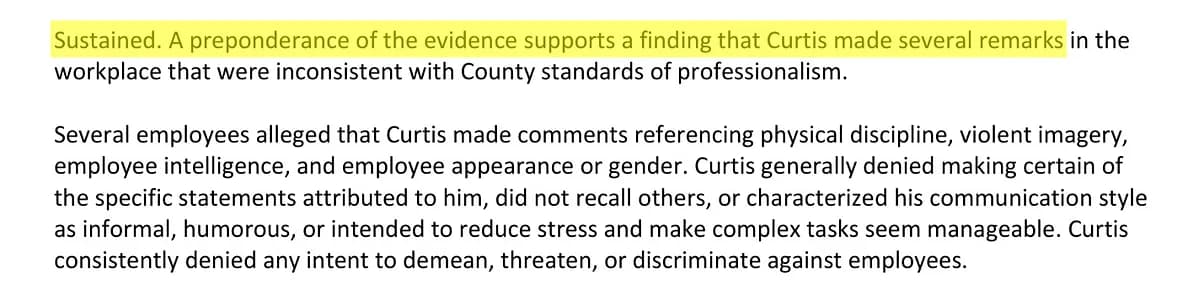
2. Inappropriate, demeaning, and threatening comments: Sustained.
This was the most significant finding. The report documented a pattern of remarks investigators concluded exceeded appropriate professional boundaries for a department head. Specific findings, each sustained:
• "Spanking" remark. Multiple witnesses, including one whose contemporaneous text messages were obtained as Exhibit 15, reported that Curtis made a comment in front of a group stating he would "spank" a female employee after she walked away. He also used what the report described as "exaggerated violent imagery," including saying, "For people who don't want to follow instructions, we will just kill them." The report found these remarks, even if intended as humor, were inconsistent with county standards.
• "Monkey" comments. Curtis told employees that election work was something "a monkey could do." When a staff member corrected him, he replied: "No it's something a monkey can do; you're a good monkey trainer." He referred to union representatives as employees' "mommies." Curtis acknowledged the "mommies" reference but denied the "monkey" phrasing; the investigation found the accounts reliable based on contemporaneous documentation.
• Appearance-based and gender-referenced comments. Multiple employees reported Curtis repeatedly calling female employees "pretty" or "dear" — on some accounts approximately a dozen times. He was told to stop and eventually did. The investigation also sustained a finding on a remark in which Curtis told a female employee she "probably don't know how to use a tape measure because you're a female." Curtis denied making gender-based remarks.
The report's overall conclusion: "the evidence supports a finding that Curtis engaged in a pattern of informal, exaggerated, and appearance-focused commentary that exceeded appropriate professional boundaries for a supervisory official."
3. Public admonishment of an employee at the June 17 open house: Sustained in part.
Multiple witnesses described Curtis publicly admonishing a staff member in front of colleagues and a poll worker after the employee responded to a question about the transition from electronic Poll Pads to paper rosters. The investigation found the admonishment occurred and was inconsistent with county workplace standards. It did not sustain the allegation that Curtis raised his voice; the evidence on that specific claim was insufficient.
4. Employment actions affecting a subordinate: Mixed findings.
The staffing and reclassification timeline, documented through county HR records and email correspondence, showed a complex multi-step process that preceded and overlapped with Curtis's tenure. The findings on whether employment actions constituted retaliation were more limited in scope.
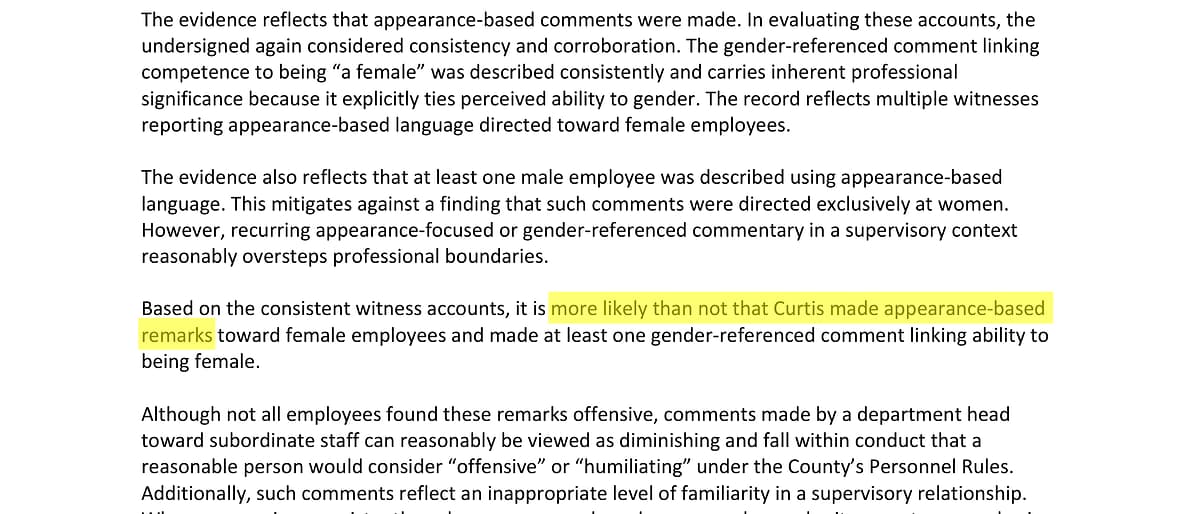
5. Disparate treatment based on gender: Sustained.
Based on consistent accounts of appearance-based comments directed primarily at female employees, the gender-referenced tape measure remark, and patterns described by multiple witnesses, the investigation concluded it was "more likely than not that Curtis made appearance-based remarks toward female employees and made at least one gender-referenced comment linking ability to being female." Recurring appearance-focused commentary in a supervisory context "reasonably oversteps professional boundaries," the report found.
One allegation that surfaced publicly at the April 28 meeting — that Curtis threatened to have a female employee "pulled out of her office by her hair" — was referenced by Supervisor Crye during the board's discussion of the closed session. Crye noted that the employee who made the allegation didn't make the complaint, that they likely thought it was no big deal.
Kevin Crye -
"Let it go. It's no big deal."
Here is a full version of the redacted investigative report.
ELECTION SPENDING — FOUR ITEMS ON THE CONSENT CALENDAR, ALL FROM CURTIS
Among the most practically significant items on Tuesday's agenda are four consent calendar items concerning election administration contracts. All four list Clinton Curtis as department contact and staff report approver. All four involve multi-year commitments to vendors central to how Shasta County currently runs elections.
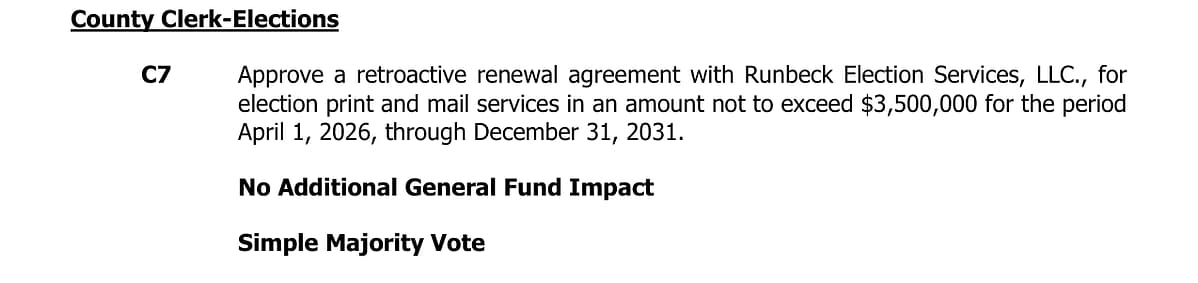
C7 — Runbeck Election Services: Ballot Print and Mail, $3.5 Million (Retroactive)
The board is asked to approve a retroactive renewal agreement with Runbeck Election Services, LLC, for ballot print and mail services. The contract amount is not to exceed $3,500,000 over the full term — capped at $350,000 per election — and runs from April 1, 2026 through December 31, 2031.
The word "retroactive" matters here. Shasta County's previous agreement with Runbeck expired in December 2025. The county has been operating without a valid contract with this vendor for approximately four months. The new agreement's start date of April 1, 2026 is itself retroactive to cover the gap.
The staff report, signed by Curtis, is explicit about the stakes: "The County will not be able to meet federal obligations without this service." Runbeck, per the agreement, handles the printing of ballots, quality control, chain of custody, inserting, mail sorting, and final audit paperwork for all ballot packets. The prior agreement dated to June 18, 2019.
C8 — Runbeck Election Services: Agilis Ballot Sorting System
The board is also asked to approve a separate renewal with Runbeck for licenses, programming, and maintenance for the Agilis Ballot Sorting System — the county's automated ballot sorting hardware used in election processing. No dollar amount was broken out separately from the staff summary on the agenda face, but the agreement covers the system used to sort and process returned mail ballots. This is important for yet another reason, Registrar Clint Curtis canceled portions of the Agilis contract citing that it wasn't necessary to complete the process. Curtis has appeared to flip on that position with this request.
C9 — Hart InterCivic: Voting System Hardware, Software, and Support (+$350,000, Three-Year Extension)
The board is asked to approve an amendment to the county's agreement with Hart InterCivic, Inc., the county's voting system vendor. The amendment increases the maximum compensation by $350,000, bringing the total to $1,300,000 over the agreement's full term, and extends the term by three years.
Hart InterCivic provides ballot design, tabulation, reporting, and ADA accommodations — the core infrastructure through which Shasta County administers elections. The original agreement was executed May 16, 2023. The staff report, signed by Curtis, warns that "the current agreement will expire prior to the June 2, 2026, Election and the County will not be able to meet federal and state ADA statutory obligations without this service."
C10 — DFM Associates: Election Management Software (+$995/Month, Extended to 2028)
The board is asked to approve an amendment to the master agreement with DFM Associates for its Election Information Management System (EIMS) software, which the county has used for "several decades." The monthly lease increases to $7,865, paid in advance. The term extends to June 30, 2028. Unlike the other three items, this one carries a General Fund impact — the monthly fee increase of $995 runs through the end of FY 2025-26 and will be included in future elections budget appropriations.
The staff report notes that California has only two vendors capable of supplying this type of software in conjunction with the statewide voter registration database
The political tension these items create is real.
Four contracts. All submitted by the man the board nearly censured last week. All extending or expanding the county's commitment to the electronic voting infrastructure that Measure B — the ballot measure Curtis championed and that Shasta County voters will decide on June 2 — would largely dismantle or sharply restructure. And this is despite Curtis himself decrying these electronic methods.
Measure B, which survived a legal challenge and will appear on the June 2 ballot, would require hand-counted paper ballots at the precinct level, one-day in-person voting with limited exceptions, voter ID, and local voter roll control without an internet connection. The Hart InterCivic voting system, the Agilis ballot sorting hardware, and the DFM election management software are all part of the infrastructure Measure B targets.
The board is being asked to approve multi-year contracts for that infrastructure — submitted by the official whose conduct it is still evaluating — 28 days before voters decide whether to replace that infrastructure.
The staff reports make the near-term stakes plain: the county has federal and state obligations it says it cannot meet without these vendors, particularly for the June 2 election. Whether the board approves, pulls individual items from consent, or requests further discussion is worth watching.
BRENT TURNER / PATRICK JONES — ALLEGATIONS
Former Shasta County Supervisor Patrick Jones made allegations involving Brent Turner, the current Assistant Registrar of Voters, according to reporting by Shasta Unfiltered.
According to Jones's account, Turner recently received a phone call from someone in Shasta County's Support Services Department who read him his Miranda rights and accused him of falsifying timecards.
Jones argued the accusation was baseless. Turner — a Bay Area-based open-source voting advocate who was brought in to fill the role vacated when Curtis fired Francescut — is battling Stage 4 cancer and has been performing his duties from home under a formal medical accommodation. Turner is a salaried employee and does not use timecards. Jones characterized the call as illegal harassment directed at a county employee.
Turner has reportedly filed or is pursuing a civil rights claim against the county, according to Shasta Unfiltered's account of Jones's radio appearance. The specific basis, procedural status, and defendants in any such claim have not been independently confirmed through court records reviewed for this article.
Jones has his own active $56 million lawsuit against the county and District Attorney Stephanie Bridgett — a conflict that is relevant context when weighing his claims.
Curtis was also stated he has filed suit as well. The nature, defendants, and status of any Curtis filing were not confirmed in records reviewed for this article.
Jones also used the appearance to characterize the Oppenheimer investigation and the censure effort as an act of "electioneering" — timed to damage Curtis in the weeks before the June 2 primary. Curtis made the same argument at the April 28 meeting.
THE BROADER PICTURE — ELECTIONS, ADMINISTRATION, AND WHAT IS AT STAKE
The May 5 meeting takes place inside a political context that cannot be separated from the administrative one.
Curtis was appointed to the Registrar of Voters position in May 2025 by a 3-2 board vote — Crye, Kelstrom, and Harmon in favor; Long and Plummer opposed. He had no prior experience in election administration and had never lived in Shasta County before his appointment. David Becker, of the Center for Election Innovation & Research and a former U.S. Department of Justice attorney, told the LA Times in March 2026 that he couldn't imagine "bringing in someone who is neither an election administrator nor a Californian for a job like that and basically chasing out experienced election officials whose work had withstood scrutiny for decades." He fired Joanna Francescut — who had 17 years in the elections office and six as assistant ROV — two weeks after being appointed. She is now his opponent on the June 2 ballot.
Whoever wins that race will administer the same election they're running in — including the Board of Supervisors races for Districts 1 and 5. Crye (District 1) and Kelstrom (District 5) are both on the June 2 ballot. Both voted to appoint Curtis in May 2025. Both voted in April 2026 to defer his censure until after that election. The office Curtis currently runs will certify their results.
The same office now under investigation, facing union complaints, multiple threatened or filed lawsuits, and a deferred censure will certify the results of the primary.
And this is just the latest in the controversy surrounding Curtis. In October 2025, just months after Curtis's appointment, the board voted 5-0 to formally condemn Curtis for his decision to exclude Shasta Scout, a local nonprofit news organization, from receiving press releases distributed by his office. Board Chair Crye declared on the record that the board "unanimously respects the right of the press to have free and unfettered access to public information." The First Amendment Coalition sent Curtis a letter calling the exclusion illegal and unconstitutional. The board stopped short of a formal censure that day — but issued an explicit warning that one would follow if Curtis repeated the conduct. He agreed to comply.
The April 28 censure vote would have been the second formal accountability action against him — and the first on a censure resolution. It now sits in suspension until after June 2.
THE REST OF THE AGENDA
Beyond the items above, Tuesday's meeting includes:
Regular calendar — Board matters:
• R1 — Employee of the Month: Amanda Hemenway, Supervising Juvenile Detention Officer, Probation Department.
• R2 — Proclamation designating May 3–9, 2026 as National Correctional Officers' Week (sponsored by Kelstrom).
• R3 — Proclamation designating May 14, 2026 as Peace Officers' Memorial Day; courthouse flag at half-staff (sponsored by Long).
• R4 — Presentation from the Farm Advisor and Shasta County's 4-H Ambassador (sponsored by Harmon).
• R5 — CEO update on county issues; supervisor reports.
• R6 — Discuss establishing funding transparency and due diligence standards for nonprofits receiving County funding; direct staff to review existing administrative policies and return to the board with recommendations. (Sponsored by Supervisor Plummer.) No fiscal impact; simple majority vote.
Scheduled hearings:
• R7 — Public hearing; adopt resolution retroactively appointing John Heath as Interim Public Works Director effective May 3, 2026, for up to 180 days. Compensation set at E-step of the established salary range ($98.91/hour / $17,144/month). (Support Services.) No additional General Fund impact. Background: Public Works Director Troy Bartolomei announced his retirement effective May 1, 2026; the interim appointment fills the gap while a permanent search proceeds.
• R8 — Public hearing; adopt findings from Planning Commission Resolution 2026-005; adopt a Mitigated Negative Declaration under CEQA; introduce and enact Zone Amendment 25-0002 (Vingenzo Colletti dba Zinco Holding, LLC) changing approximately 1.5 acres at 17014 Keswick Dam Road from Interim Rural Residential (I-R) to One-Family Residential (R-1); approve Tract Map TR25-0001 for a six-parcel subdivision. (Resource Management.) No additional General Fund impact.
• R9 — Public hearing; Zone Amendment 25-0003; introduce and enact an ordinance repealing and replacing Section 17.88.132 of the Shasta County Code to update rules governing Accessory Dwelling Units countywide. CEQA-exempt under multiple provisions. (Resource Management.) No additional General Fund impact.
Closed session:
• R10 — Real property negotiators: parcels at 3905 Shasta Dam Boulevard; negotiators are CEO Rickert and Senior Administrative Analyst Bryce Ritchie.
• R11 — Existing litigation: Tyler Thompson v. County of Shasta (workers' compensation); Marily Woodhouse v. County of Shasta (Superior Court No. 210492); Isaiah Gray v. County of Shasta et al. (Eastern District of California No. 2:26-cv-01558-DC-DMC).
• R12 — Anticipated litigation arising from Curtis's threat. (See full section above.)
Other consent calendar items of note:
• C11 — Renewal agreement with CAL FIRE for administration of the Shasta County Fire Department, not to exceed $11,281,827.
• C12/C13 — Housing budget amendments (CalHOME and Home IPP programs).
• C14 — Retroactive agreement with the California Mental Health Services Authority for healthcare effectiveness measurement.
• C15 — Proclamation designating May 2026 as Community Action Month.
WHAT TO WATCH
• Closed session report-out. Item R12 is the most significant closed session item on the board's docket in months. County counsel's post-session report to the public will indicate whether any action was authorized in response to Curtis's litigation threat. Even a "no reportable action" is information.
• Consent calendar votes on C7–C10. Watch whether any supervisor pulls one of the four election items for separate discussion. The vote on election infrastructure contracts submitted by Curtis, during an active censure controversy and four weeks before a primary that includes a measure targeting that infrastructure, may not be as routine as a consent calendar listing implies.
• Public comment. The April 28 meeting drew sustained public comment for and against Curtis. Tuesday's meeting — the first regular session since R12 became public — could as well.
• Board statements. Supervisors may use their reports under R5 to address the ongoing situation. Given the events of the past week, this promises to be a substantive meeting.
The June 2 primary is 28 days away and ballots have begun mailing as of today, 5/4/2026.
The meeting will stream live on the county's website and on the North State Breakdown Facebook page.