

Two Whistleblowers Sue Shasta County Over Alleged Retaliation for Reporting Corruption
 By Benjamin Nowain•May 17, 2026•11 min read
Shasta County's former sheriff and the county's own senior attorney have filed separate lawsuits alleging they were fired in retaliation for refusing to go along with misconduct — one involving a casino deal that shortchanged the county by more than $212 million over 30 years, the other involving a direct order to submit a false declaration in open court.
The two lawsuits were filed just 34 days apart in 2026. Both invoke California's whistleblower protection statute. Both name the same county as defendant. And both describe a workplace where employees who said no were removed, while those who gave the orders remain in place — in one case, with a new four-year contract.
A Shasta County Superior Court judge has since independently confirmed the central claim of the first lawsuit: in July 2025, Judge Stephen H. Baker voided the Board of Supervisors' 2023 approval of the Redding Rancheria casino agreement, finding that the county violated its own contract manual and that county officials including the Sheriff, District Attorney, and Fire Chief had all opposed the deal — and were deliberately excluded from the process. A separate Fair Political Practices Commission investigation into the Board member who directed the deal is open and pending.
Case One: The Sheriff Who Refused to Stop
Eric R. Magrini was appointed Shasta County Sheriff in December 2019. During the COVID-19 pandemic, as state public health orders required county compliance, Supervisors Kevin Crye and Patrick Jones pressured him to stop enforcement. He refused, citing his oath of office and his belief that non-enforcement would violate OSHA requirements and the Governor's executive orders.
His lawsuit states the consequences were immediate and personal. Board members told him he had been a "traitor to the Republican Party, and to those who objected to the imposition of COVID-19 health orders." The complaint further alleges that at least two Board members confirmed to Magrini that he had been placed on what the complaint calls a "hit list" — a list of county officials targeted for removal because they had enforced COVID mandates.
He resigned as Sheriff in June 2021 and took a newly created position: the county's first Assistant CEO. In that role, he personally led negotiations with the Redding Rancheria tribe on a proposed Intergovernmental Agreement for a new casino at the Strawberry Fields site along Interstate 5.

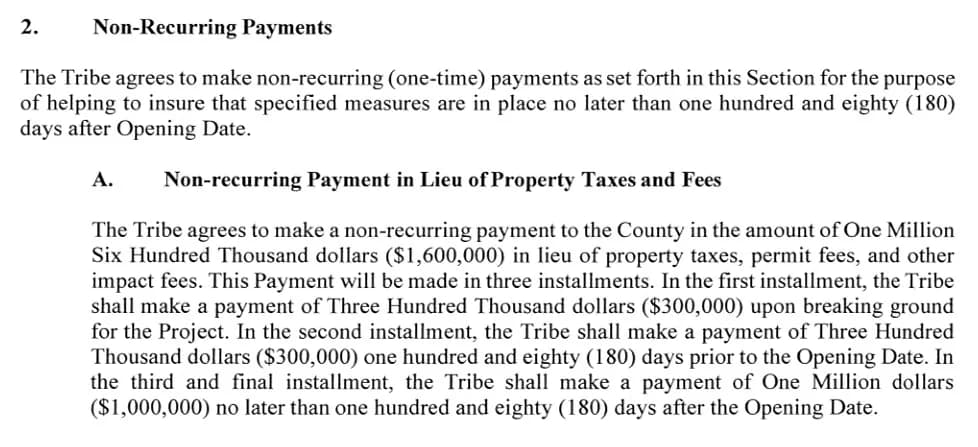
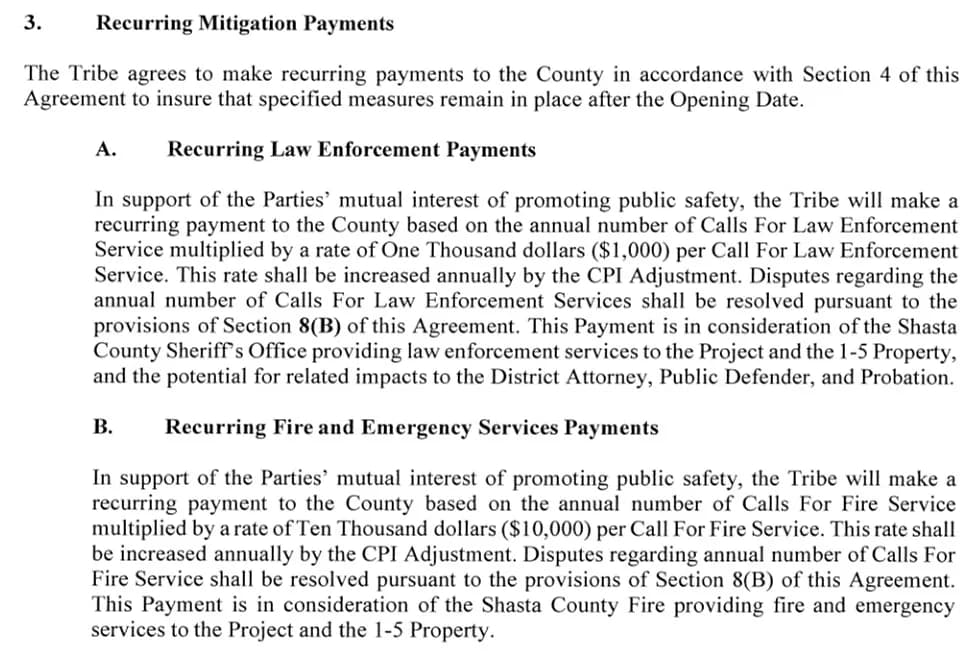
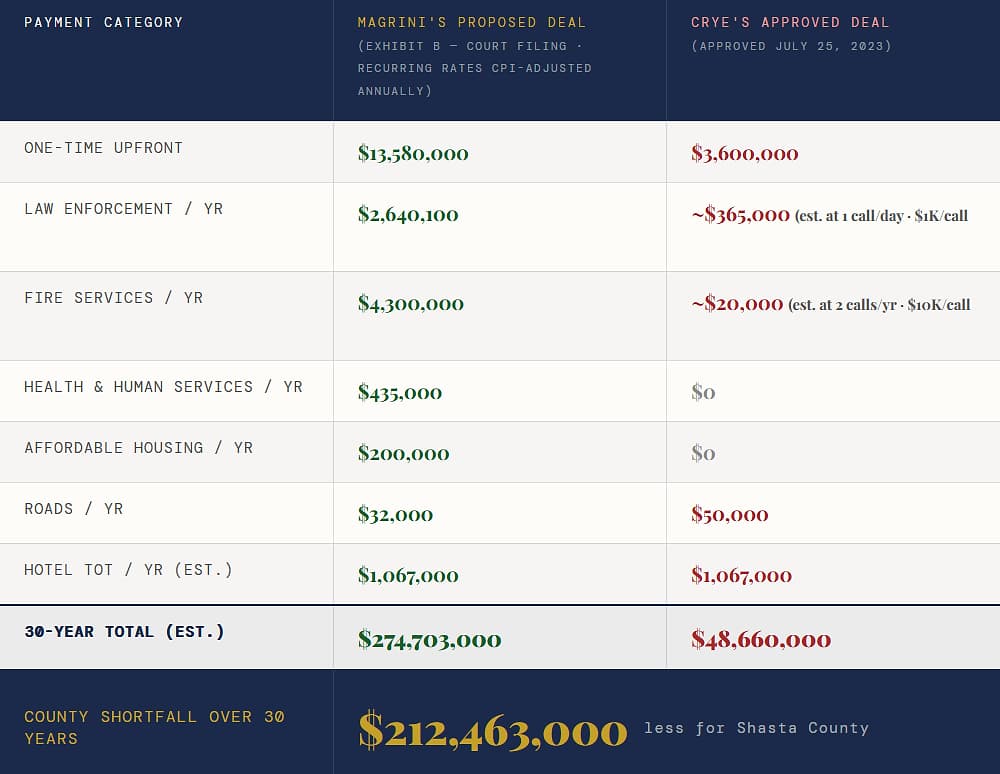
Magrini's proposed deal, detailed in court exhibits attached to his lawsuit, specified $13.58 million in upfront payments and $8.704 million per year in recurring mitigation payments — covering law enforcement costs, fire services, health and human services, affordable housing, and roads.
The deal the Board ultimately approved on July 25, 2023 — one that, according to the BOS's own staff report, was presented "at Supervisor Crye's direction" — called for $3.6 million upfront and roughly $1.5 million per year. The 30-year gap between the two versions: $212,463,000.
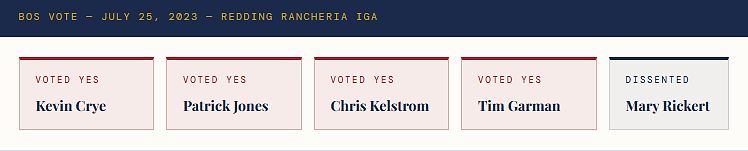
The vote on July 25, 2023 was 4 to 1. Supervisor Mary Rickert cast the sole dissenting vote. Crye, Jones, Supervisor Chris Kelstrom, and Supervisor Tim Garman voted yes.
In late 2022, the Tribe itself disclosed Crye's interference to Magrini directly. During a meeting with Tribe representatives, they told him they had been having separate meetings with Board Member Kevin Crye, and that certain terms might need to change. Magrini reported the interference to the Interim CEO and County Counsel. After Magrini went on medical leave in March 2023, Crye took over as lead negotiator "to the exclusion of County staff." Months later, a Tribe representative told Magrini that the Tribe "had no reason not to accept the (extremely) discounted deal that Mr. Crye offered."
In late 2022 and early 2023, Magrini reported the §87100 conflict of interest, Board workplace harassment, and violations to OSHA and the California Civil Rights Department.
The complaint also alleges that Crye and Jones engaged in sexual harassment against county employees who reported to Magrini — "stalking their family members, subjecting County staff to irrational tasks, and screaming at them for just doing their job." He reported that misconduct to Human Resources and the CEO.
Campaign finance records confirm what Magrini reported. The Redding Rancheria donated $4,000 to Crye's 2022 supervisorial campaign on October 12, 2022 — a legal campaign contribution at the time it was made. The conflict arose nine months later, when Crye voted on the IGA: under Government Code §87100 and §87103, an official who has received a contribution from a party within the preceding 12 months must recuse before any vote involving that party. The violation is voting without recusing, not the donation itself. Magrini reported this conflict to county officials. The tribe then donated a further $5,500 to "STOP NEWSOM: NO ON CRYE RECALL" — the committee that kept Crye in office when he faced a recall election he survived by 50 votes. That post-vote donation raises a separate concern: under §84308, a party to a proceeding cannot make contributions to an officer for 12 months after a final decision, regardless of the pre-vote question. Combined, that is $9,500 in tribal money flowing to Crye's political benefit — the precise figure cited in Magrini's complaint. Supervisor Jones, who also voted yes and co-signed the "don't speak to him" order against Magrini, received $5,500 from the Rancheria in November 2023 for his 2024 campaign.
After Crye voted yes on the deal, the tribe donated $5,500 to the anti-recall committee that kept him in office when he faced a recall election he survived by 50 votes. Combined, that is $9,500 in tribal money flowing to Crye's political benefit — the precise figure cited in Magrini's complaint. Supervisor Jones, who also voted yes, received $5,500 from the Rancheria in November 2023 for his 2024 campaign.
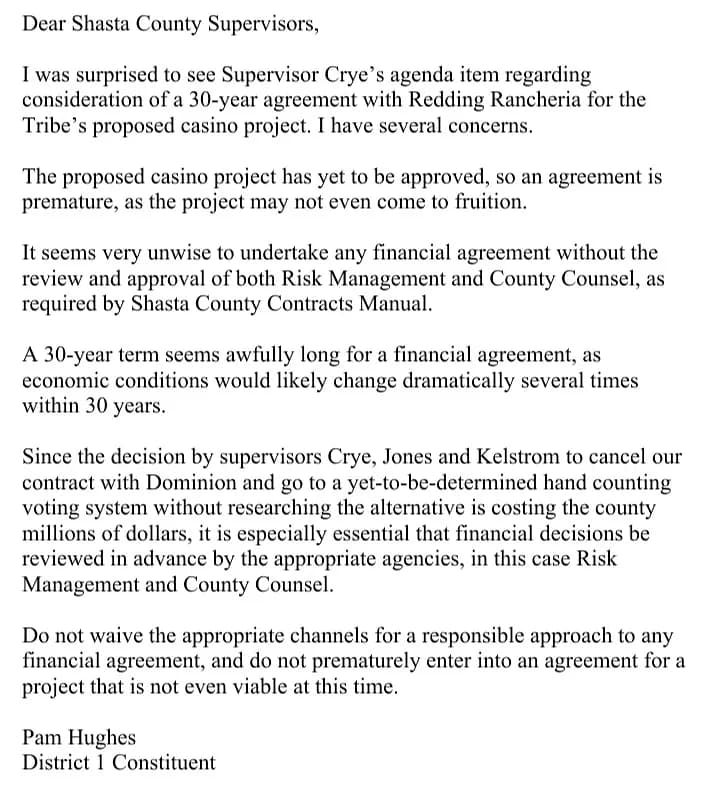
The Retaliation: A Cascade of Adverse Actions
The Magrini complaint describes a sequence of retaliatory actions that escalated over two years. In January 2023, Crye attempted to eliminate the Assistant CEO position entirely — legally impermissible. The complaint states Crye and Kelstrom were "pressuring the Acting CEO to terminate" Magrini. In early 2023, Magrini was struck from the CEO candidate list despite being ranked most qualified by an independent recruiter.
In March 2023, the complaint alleges something more alarming. Magrini learned Crye had stalked his wife at her place of employment — a church in Anderson, California, where she worked as a secretary, alone in an office at the back. Anderson is a city Crye has no official business in. The complaint states Ms. Magrini photographed Crye that day, and he quickly left the scene. The incident was reported and investigated. It was confirmed Crye knew the family's church, wife's workplace, and granddaughter's school. Some months later, Crye also appeared at the granddaughter's school.
In April 2023, Magrini was placed on administrative leave. A memo from County Counsel Jim Ross directed all Board members to refrain from any contact with Magrini. Board Chairman Patrick Jones confirmed the memo to the Record Searchlight that May.

The county also revoked Magrini's previously approved outside employment — ordering him to cease work as a Concealed Carry Weapon Program instructor and as a licensed real estate broker, jobs he had held with the county's knowledge. The lawsuit also alleges that Crye "knew that he (Magrini) was suffering from life threatening health conditions while he screamed at Mr. Magrini" — a reference to the heart conditions the complaint says Magrini developed as a result of the workplace harassment.
In early February 2024 — while Magrini was on medical leave — the county notified him he would be denied access to the building, his office, and his desk. The county then searched his personal belongings without his presence, including work papers and notes relating to the Redding Rancheria project. The county claimed the search was "County policy" for employees on medical leave; the complaint states this claim was incorrect.
On August 23, 2024, county officials held a formal meeting with Magrini. He was terminated immediately after. As a permanent public employee, the complaint calls the meeting a "sham disciplinary meeting."
The complaint also names Supervisors Crye, Jones, and Kelstrom for their conduct throughout the retaliation period.

The Court Record: A Judge Independently Confirmed What Magrini Reported
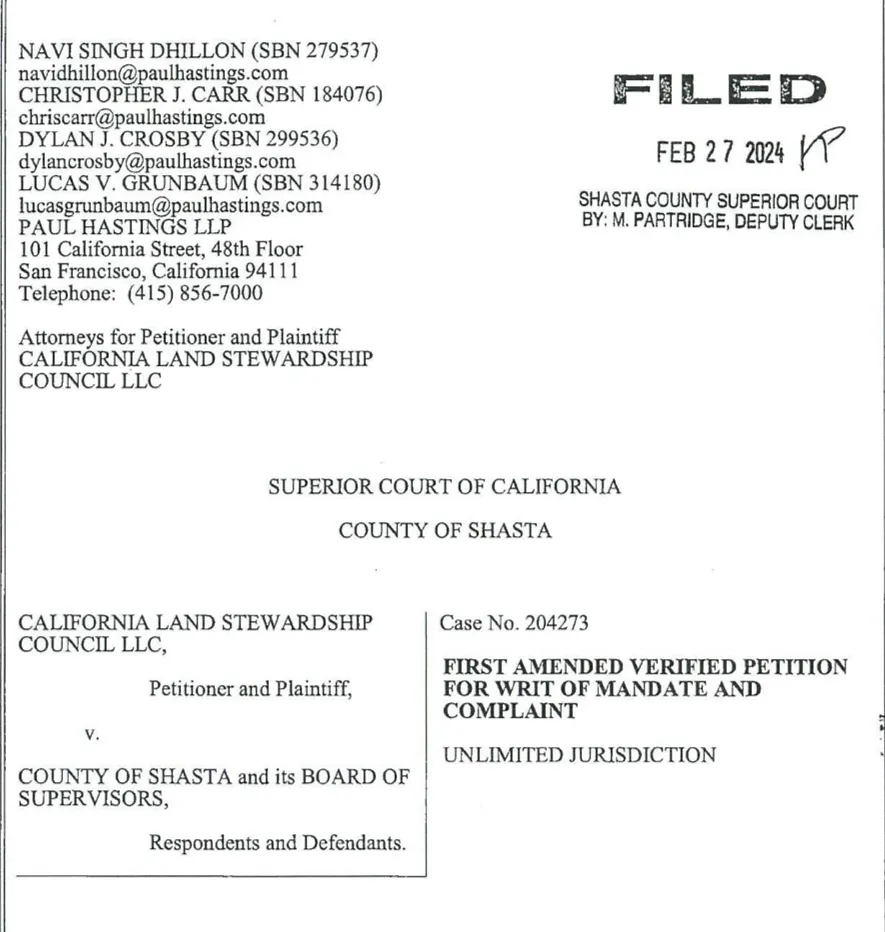
In February 2024 — while Magrini was on medical leave and before he had been formally terminated — the California Land Stewardship Council, LLC filed a writ of administrative mandamus in Shasta County Superior Court seeking to void the Board's July 2023 IGA approval (Case No. 24CV-0204273). Judge Stephen H. Baker issued his ruling on July 14, 2025.
Baker found that the BOS's decision to approve the agreement "was not authorized by law" and set it aside. His three findings map almost precisely onto what Magrini had alleged.
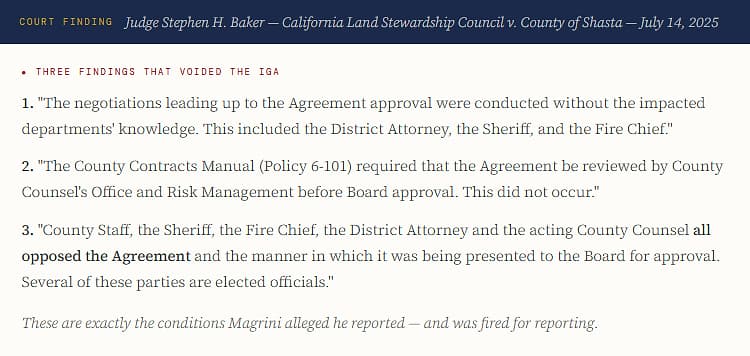
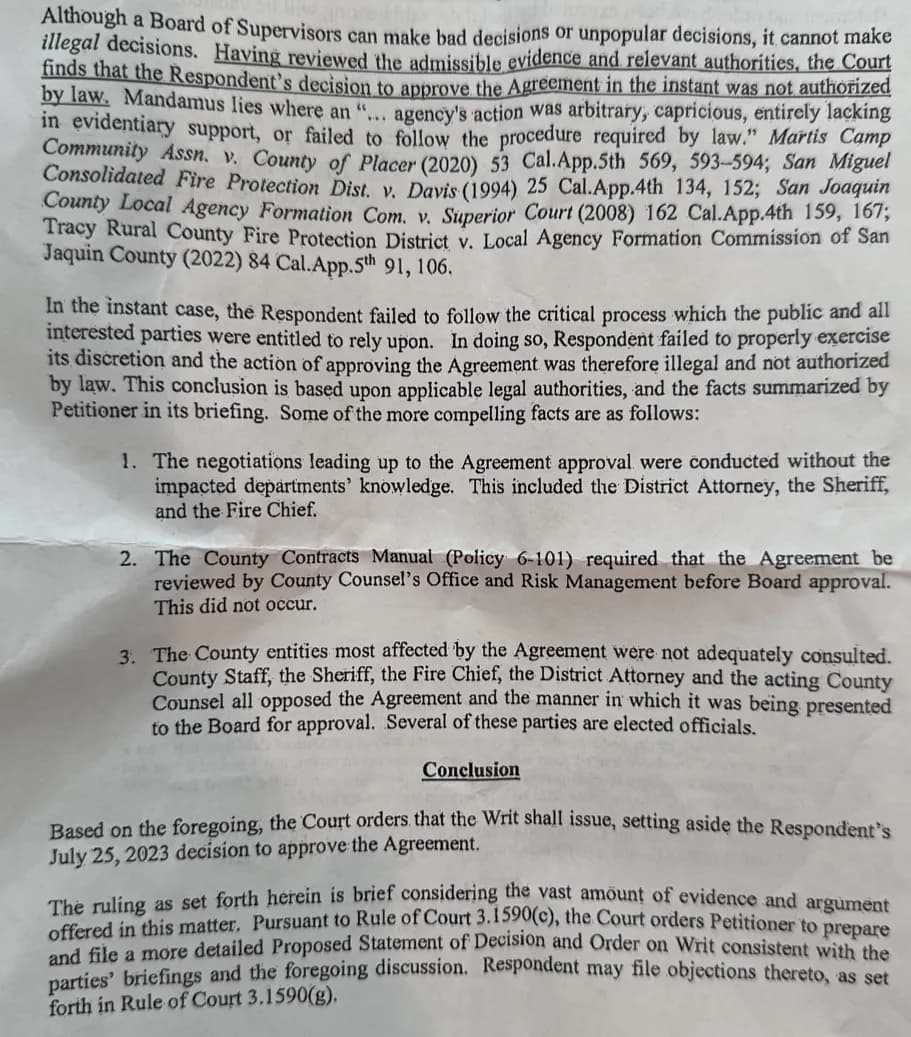
These are the exact conditions Magrini said he reported in 2022 and 2023: that the negotiations were being run around the official process, that county staff and elected officials were excluded and opposed the deal, and that county policy was being bypassed. A judge found all of it to be true — after Magrini had already been fired.
At the August 12, 2025 Board meeting — less than a month after the ruling — the Board approved a new four-year employment contract for Joseph Larmour as County Counsel. Larmour had been present at the April 2025 hearing defending the county's position on the agreement Baker subsequently voided. He is also the subject at the center of the second lawsuit.
Case Two: The Attorney Ordered to Commit Perjury
Alan B. Cox has been a licensed California attorney since 2005. He spent six years at the Tehama County Counsel's office before joining Shasta County, where he served sixteen years — from 2008 to 2025 — as Deputy and then Senior Deputy County Counsel. The complaint describes him as having "an impeccable reputation for ethical practice and professional integrity." The people who ordered him to break the law were his own supervisors: Joseph Larmour and Patricia Weber, both Supervising Attorneys.

Two separate matters are at the center of Cox's complaint. The first involved Towd Point Mortgage Trust v. Estate of Melvin Dean Frisbee (Shasta County Superior Court No. 206370). On February 6, 2025, Weber ordered Cox to immediately file a General Denial. Cox discovered the filing deadline had expired January 10 — 30 days earlier. He told Larmour. Larmour ordered him to file anyway. Cox filed under pressure. On February 11, the court struck the General Denial — a default had already been entered.
What followed is the core of the case. Larmour and Weber directed Cox to file a Motion to Set Aside the Default — requiring him to submit a declaration falsely claiming he was responsible for the missed deadline.
The complaint alleges Cox discovered the truth: Larmour himself was the attorney responsible for the Towd Point case and had failed to file the timely answer. They were not asking Cox to cover for a generic county mistake — they were asking him to personally take the blame for his supervisor's own error in a court filing.
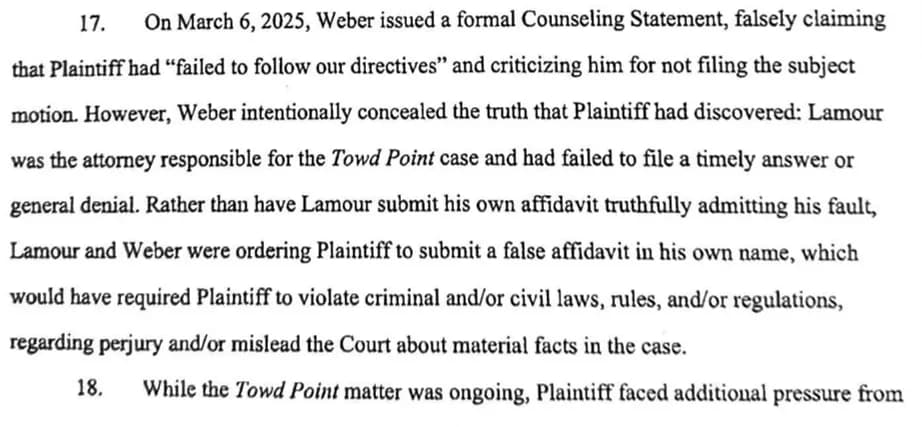
Cox refused, citing Rules of Professional Conduct 1.2.1, 1.3, and 3.3 and Business & Professions Code §6068. Weber issued a written directive on February 20, 2025 ordering him to file anyway. Cox refused again.
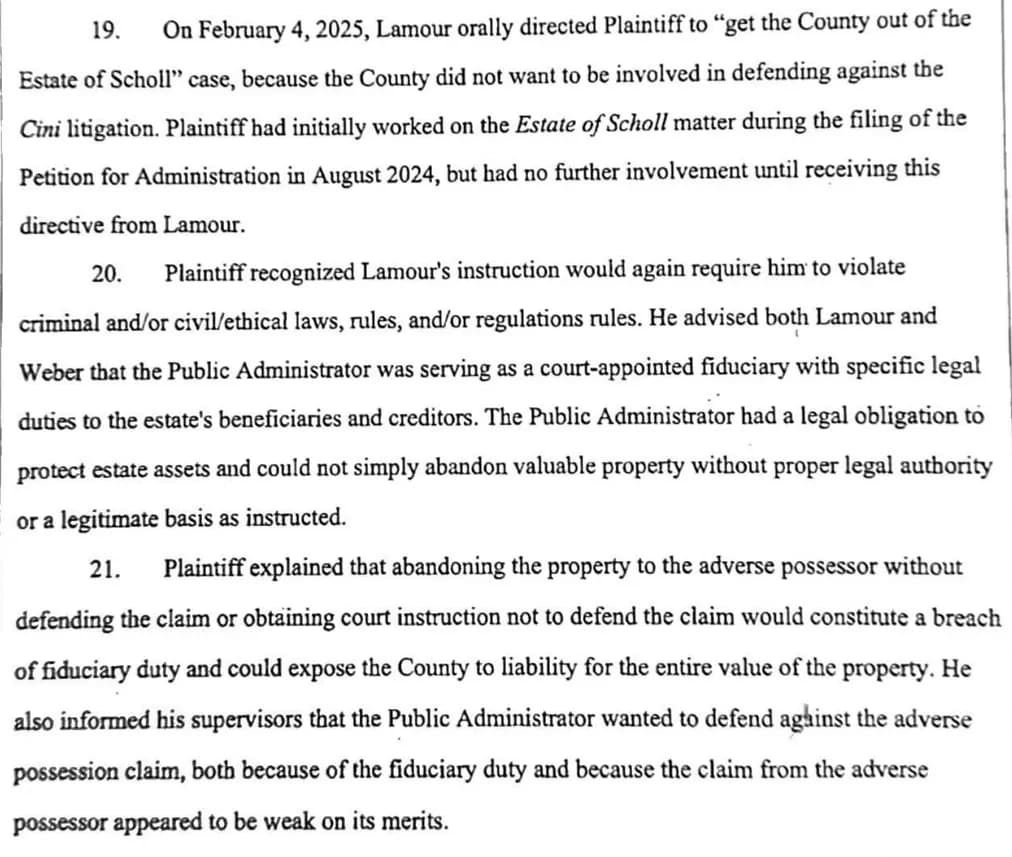
Weber issued the February 20 directive "ordering him to file the Motion." The complaint reveals Lamour was the responsible attorney — he had "failed to file a timely answer or general denial" and supervisors wanted Cox to cover for the mistake.
The second matter involved the Estate of Dorothy P. Scholl (Case No. 32536), where the Shasta County Public Administrator served as court-appointed Personal Representative of an estate valued at $179,000. On February 4th 2025, Larmour directed Cox to "get the County out of" the Scholl case to avoid defending against an adverse possession claim. Cox warned abandoning the property without court authority would breach fiduciary duties to the estate's beneficiaries and Medi-Cal, which had a creditor's claim. Weber issued a second written directive on March 11, 2025 ordering Cox to abandon the property anyway.
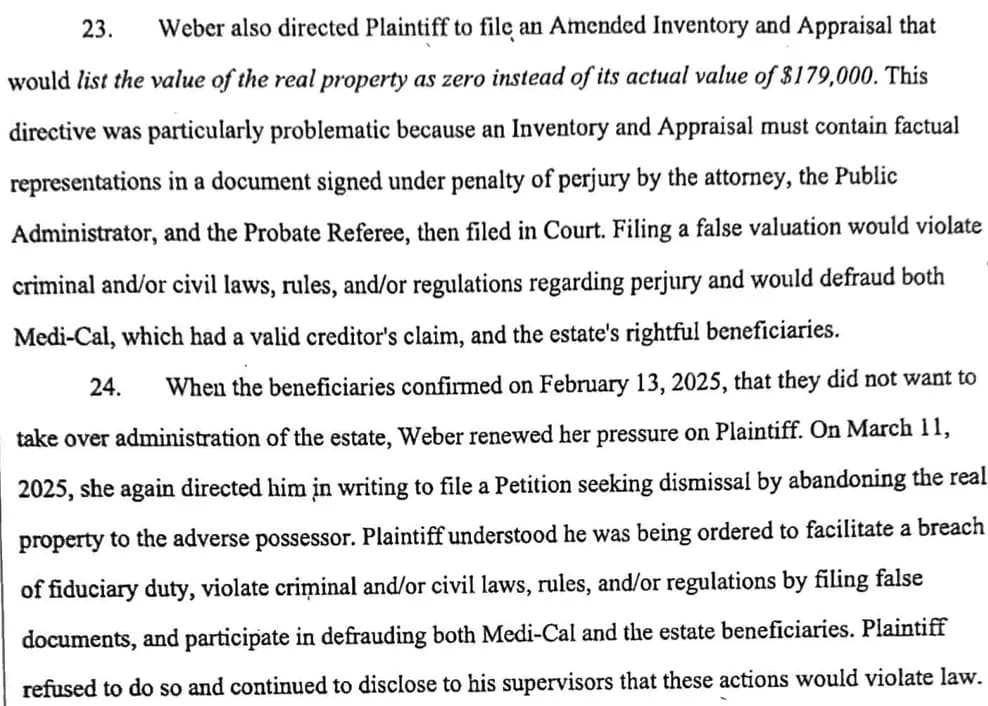
Cox refused both directives. He disclosed the violations to a government or law enforcement agency — protected conduct under Labor Code §1102.5. The complaint also alleges he was retaliated against for reporting and opposing discrimination based on race and ethnicity.
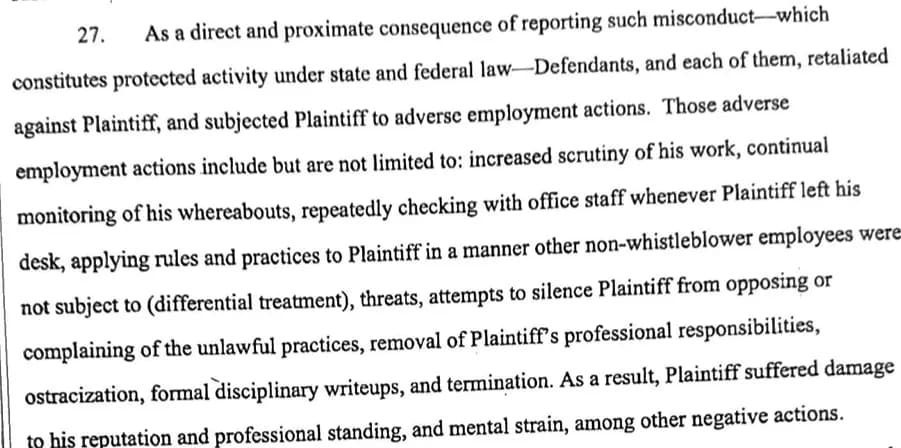
The complaint lists the adverse employment actions Cox faced: increased scrutiny of his work, continual monitoring of his whereabouts, staff reporting when he left his desk, removal of professional responsibilities, ostracization, formal disciplinary writeups, and termination. It also alleges retaliation for opposing race/ethnicity discrimination.

Cox was terminated on May 28, 2025. On the same day, two other county employees were terminated: Laura Stapp and Trisha Boss, both HHSA Deputy Branch Directors. A public records request asking about all three employees by name was filed within 14 days.
Cox's complaint goes further than his own circumstances. It alleges that the county maintained "policies designed to prevent employees from disclosing information to a government or law enforcement agency" — a systemic allegation, not just a claim about two bad supervisors. Among his requested remedies: a court order requiring the county to post permanent notices of whistleblower rights in all county offices.
The Convergence: One Name, Two Cases, One Month
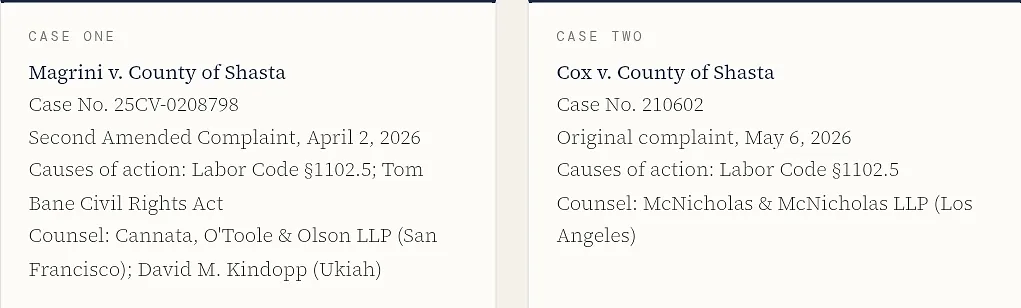
The two lawsuits converge on Joseph Larmour. In February 2025, Larmour was directing Cox to file knowingly defective pleadings and then pushing him to commit perjury when those pleadings failed. Two months later, in April 2025, Larmour appeared as County Counsel at the hearing in which Judge Baker was weighing whether to void the casino agreement. Baker voided it in July. In August 2025, the Board gave Larmour a new four-year contract.
Baker's ruling corroborates the specific claims in Magrini's complaint almost point for point. Magrini alleged that Crye was running secret, parallel negotiations that excluded county officials who opposed the deal. Baker found exactly that — and found that the Sheriff, DA, Fire Chief, and acting County Counsel all opposed the agreement and were kept out of the process. Magrini says he reported this pattern and was terminated. Baker says the pattern was real and the deal was illegal.
The county's conduct toward Magrini extended beyond his termination. In January 2025 — five months after Magrini was fired — the Board voted to pay nearly $2.8 million to settle a lawsuit by retired Sheriff's Captain Pat Kropholler. Kropholler claimed that Magrini, as Sheriff, had retaliated against him for filing a whistleblower complaint.
The settlement came less than a month after Board Chairman Crye publicly praised Kropholler at a county recognition event on December 19, 2024. The county had previously fought to keep a related investigation — the Ellis Report — secret, until a court ordered its release in August 2023.
Kropholler claimed he was a whistleblower, and retaliated against by Magrini. Magrini claims he was a whistleblower retaliated against by the Board. The county paid Kropholler $2.8 million — and now the county is being sued by Magrini.
The Investigation: An Open FPPC Case and a June 2 Election

A sworn complaint against Kevin Crye — filed in 2023 by Redding residents Dolores Lucero and Jeffrey Gorder — is currently open and pending before the California Fair Political Practices Commission (Case No. 2023-00500). The case lists Crye as respondent four times, suggesting four separate alleged violations. The FPPC opens cases only after determining the allegations had sufficient legal basis to warrant investigation. No findings have been announced.
Under Government Code §87100 and §87103, a public official who receives a campaign contribution of $250 or more from a party within 12 months before a vote on a matter involving that party has a legally defined financial interest and must recuse. The Rancheria's $4,000 contribution to Crye's campaign came nine months before his vote on the agreement. Magrini reported this conflict internally before his termination. The FPPC complaint was filed by outside citizens, independent of Magrini's own lawsuit.
Crye has not publicly addressed either lawsuit in statements to news organizations that have covered them. On his radio show on October 5, 2025 — the day before Shasta Scout published the Magrini lawsuit story — he referred to the lawsuit's subject as a "very failed individual" and accused local media of being "very crooked."