
Revisiting the Kropholler Settlement: Shasta County Paid $2.8 Million to Settle a Whistleblower Suit. Its Own Investigator Had Already Rejected Most of the Underlying Claims.
 By Benjamin Nowain•July 16, 2026•12 min read
Back in 2025 The Board of Supervisors voted in an unannounced closed session to pay former Sheriff's Captain Pat Kropholler nearly $2.8 million to end his retaliation lawsuit against the county — five months after the county's own outside investigator found most of his allegations against then-Sheriff Eric Magrini not sustained, and his central "toxic environment" claim not credible. The board chairman who cast the deciding vote later admitted, on the record, that he wasn't sure whether the years of silence surrounding the case amounted to "total incompetence or total corruption."
The Number
On January 7, 2025, the Shasta County Board of Supervisors approved budget amendments of exactly $2,791,815 — reported publicly as "nearly $2.8 million" — to fund the settlement of Kropholler v. County of Shasta. Support Services Director Monica Fugitt told the board the item "approves... a budget amendment in the Risk Management and Sheriff's Office budgets" in response to the settlement, and that "the settlement was approved and authorized by PRISM, our excess insurance carrier," which had "since been paid" Kropholler under the terms of the agreement. The county self-insured the first $250,000 of the claim; PRISM covered the excess — softening, but not eliminating, the cost to taxpayers.

Jan. 7, 2025 — Board of Supervisors Regular Meeting: Support Services Director Monica Fugitt explains the settlement was funded through PRISM, the county's excess insurance carrier.
No court ever ruled on the case. The settlement had already been approved in closed session nearly two months earlier, on November 16, 2024, by a 3-2 vote — Board Chairman Kevin Crye, Patrick Jones, and Chris Kelstrom in favor, Mary Rickert and Tim Garman opposed. The vote was never announced. The clerk's report-out that day read simply: "No reportable action was taken." Rickert later disclosed the tally herself, at the board's Dec. 19, 2024 meeting, saying: "I was never given any information, any tangible concrete information to award $2.65 million to someone."
Dec. 19, 2024 — Board of Supervisors Regular Meeting: Rickert's "any tangible concrete information" disclosure.
Kropholler, a 28-year Sheriff's Office veteran who retired as a captain in January 2022, sued the county in 2022 alleging Magrini retaliated against him — including placing him on administrative leave days before Magrini's own resignation — after Kropholler raised whistleblower complaints. The case, Kropholler v. County of Shasta et al., Case No. 22CV-0199716, settled without a trial, a verdict, or any judicial finding on the merits of either side's claims. The Jan. 7 budget item breaks the $2,791,815 into two pieces: $2,650,000 from the Risk Management-General Liability budget and $141,815 from the Sheriff's Office budget.
What the County's Own Investigator Found
Kropholler's allegations against Magrini had already been examined once — just not in court. The Sheriff's deputies had already registered their own verdict: on January 27, 2021, the Deputy Sheriff's Association (DSA) — the rank-and-file deputies' union — cast a formal vote of no confidence in Magrini. Weeks later, Kropholler, as president of the separate Sheriff's Administrative Association (SAA), representing the department's captains and lieutenants, submitted the SAA's own letter of concerns to the Board — attaching the DSA's no-confidence vote to it. In March 2021, following that SAA letter, the county commissioned an independent investigation by Leslie D. Ellis of Ellis Investigations Law Corporation. Ellis interviewed roughly two dozen witnesses, including Magrini twice, and delivered a 168-page report on June 2, 2021, addressing 15 distinct issues Kropholler had raised.
The report sustained four of them and did not sustain eleven. Among the four sustained: Magrini acknowledged pulling an unauthorized RAP sheet on a county CEO candidate in 2019, and acknowledged running the January 2020 captain promotion testing with incorrect procedures. He also acknowledged making a map labeling a patrol station "Precinct 3" during the 2020 George Floyd protests and commenting that he hoped protesters burned the building down — a remark Magrini's supporters, including a sympathetic account published by anewscafe, have since characterized as dark humor rather than a genuine wish. The investigation didn't weigh in on his tone; it sustained the issue because the comment and Magrini's own acknowledgment of it were undisputed. What is not in dispute either way: the investigation additionally found he altered Kropholler's employee photo with a Hitler mustache, intending to use it to incite that outcome.
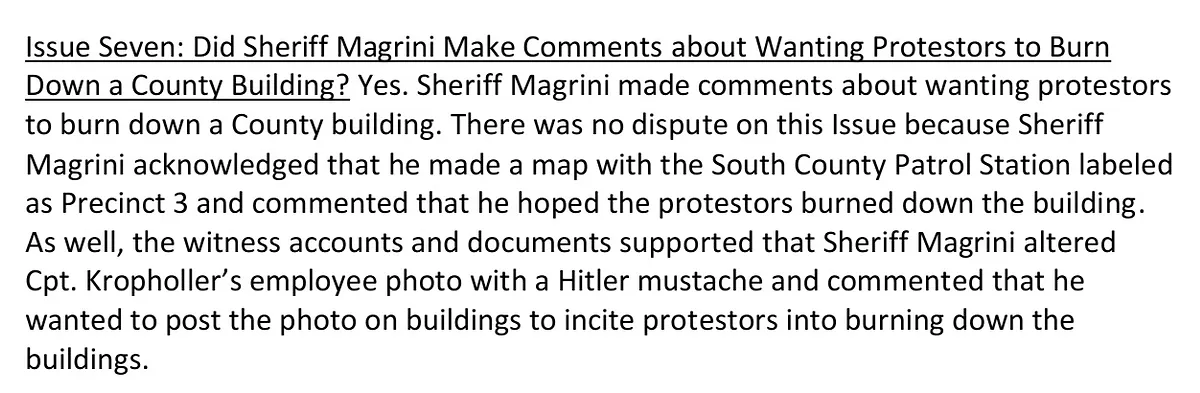
Two captains corroborated a fourth sustained allegation: that Magrini said he'd decline to send fifteen deputies to protect the Board of Supervisors because the board had postponed his pay raise. Any of the four sustained findings would likely have been a serious exhibit at trial — they are not minor, and they are why "the investigation cleared Magrini" would be as inaccurate a summary as "the investigation vindicated Kropholler."
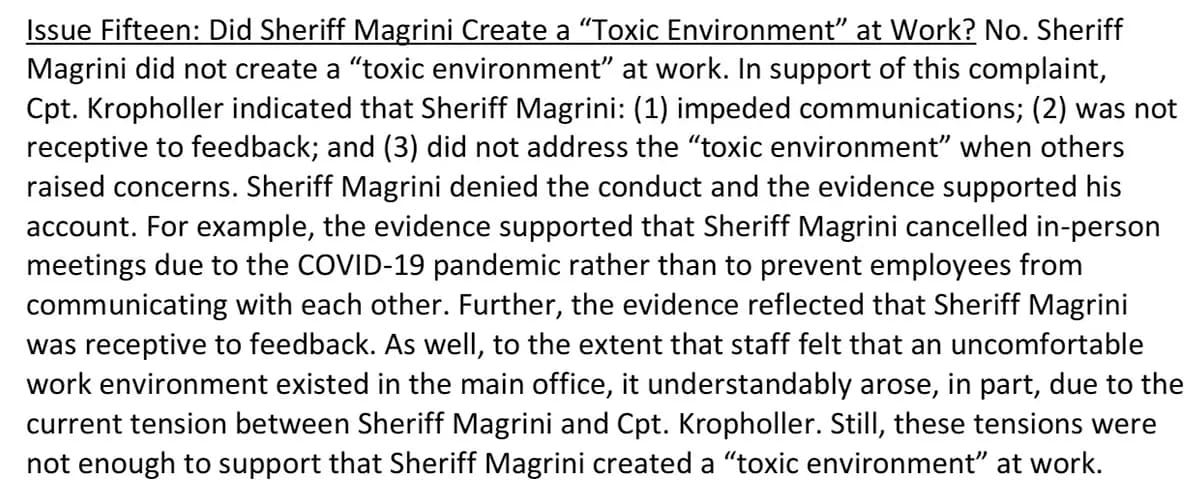
But on the eleven allegations the investigation did not sustain, the report was consistently unfavorable to Kropholler's account — including the allegation at the center of his broader narrative, that Magrini had created a "toxic environment" in the Sheriff's Office. The report's finding on that point was direct: "these tensions were not enough to support that Sheriff Magrini created a 'toxic environment' at work."
Investigators repeatedly wrote that "Cpt. Kropholler's account lacked relative credibility," citing instances where his version of events conflicted with other witnesses and documents — including his claim that a rival county employee had orchestrated the RAP-sheet pull to sabotage a promotion, which the evidence traced instead to a different staffer with no stake in the outcome. The report also noted Kropholler had "potential motives to raise a false complaint," pointing to a reassignment he'd experienced as a demotion. He declined to be interviewed for the investigation and, through counsel, declined to provide documents beyond a written summary.
The Ellis Report's full 15-issue scorecard: 4 sustained, 11 not sustained.
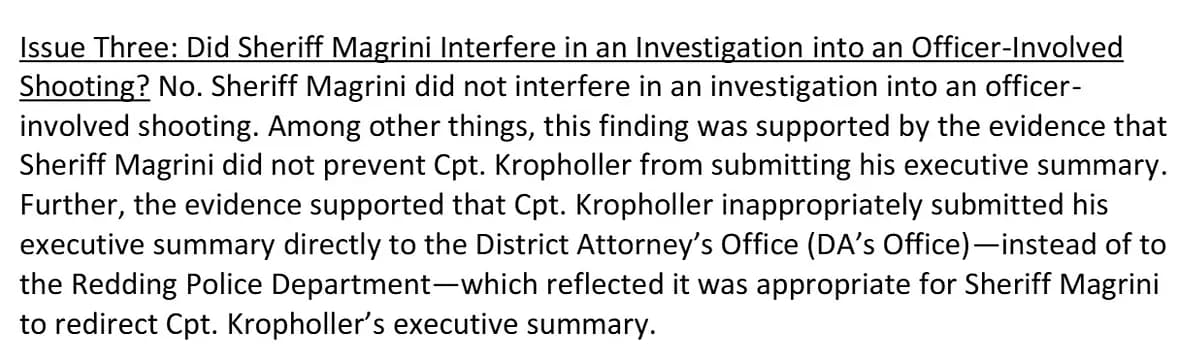
The report cut against Kropholler in at least one other respect: it found that during a 2020 officer-involved-shooting investigation, Kropholler himself improperly sent his executive summary directly to the District Attorney's Office instead of routing it through the Redding Police Department as protocol required — a violation of process on his part, in an issue where Magrini was cleared entirely.
It's worth being precise about what the Ellis Report did not address. Kropholler's age-discrimination concerns were explicitly ruled outside its scope, and the administrative leave and eventual retirement that anchor his retaliation lawsuit happened after the report was already complete. "Most allegations not sustained" and "the retaliation lawsuit lacked merit" are not the same finding — the investigation examined Magrini's conduct through mid-2021, not the legal question of whether Kropholler was later punished for raising it.
Praised, Then Paid
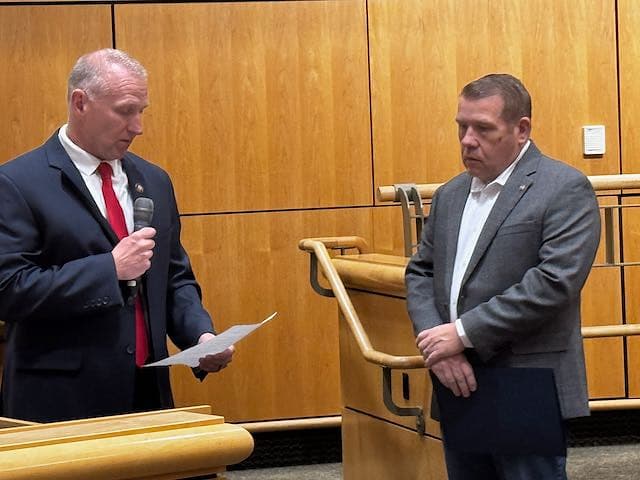
Three weeks before the county funded the settlement, the Board of Supervisors formally recognized Kropholler for his 28 years of service. The certificate — agenda item R4 at the December 19, 2024 meeting — was sponsored personally by Crye. During public comment on the item, one speaker called Kropholler a hero for blowing the whistle; Crye's own remarks on the record were more measured, telling the room he was "definitely for recognizing people who have gone by far above and beyond." Rickert and Garman abstained from the vote to approve the certificate, both citing the pending lawsuit.

What the Board Says It Didn't Know
Immediately after the certificate vote, the board moved to the next item — one Crye said he'd originally wanted to handle in closed session, until he was told that briefing the board's newer members on the full history could only happen in open session. What followed was the board's own chairman narrating, from the dais, the case that would cost the county $2.79 million three weeks later — followed by an account from another supervisor of just how little the board says it actually knew.
Crye laid out a sympathetic version of Kropholler's story himself: Magrini pressuring him in December 2019 to illegally use a state law-enforcement database to pull a RAP sheet on a CEO candidate, Kropholler refusing, and what Crye called nearly 20 months of bullying and harassment that followed, ending in Kropholler's administrative leave. Something the Ellis report doesn't corroborate.
Dec. 19, 2024 — Board of Supervisors Regular Meeting: Crye's own narration of the Kropholler backstory, opening item R13.
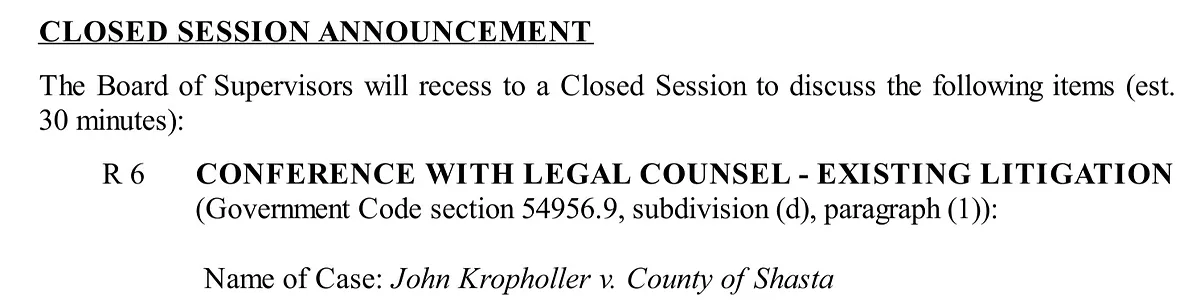
The meeting then turned into a dispute over the board's own timeline. Rickert produced a Board of Supervisors closed-session agenda from January 18, 2022 — nearly three years earlier — item R6, naming "John Kropholler v. County of Shasta," arguing the board had known about litigation involving Kropholler well before the March 2024 date Crye had publicly cited. Crye disputed it on the record: "No, we did not. You're incorrect. That's a different case." County Counsel then clarified that there were, in fact, two separate cases — one resolved after the January 2022 closed session, a second filed later — meaning neither account was entirely accurate.
Supervisor Chris Kelstrom offered his own account of how little the board knew. He recalled reading the entire Ellis Report in County Counsel's office in the spring of 2023 — two hours, then, after his outside counsel seemed to expect he'd skim it and leave, another hour and a half — with no one telling him the county was, by then, already roughly a year into active litigation with Kropholler. "It was never brought up," Kelstrom said. "It was never said we're under a lawsuit or that we're having a lawsuit. Nothing was ever said to me."
Crye also disclosed what he said was, for him, a new detail: in late 2023, an unnamed private citizen approached him and claimed they could help settle the Kropholler case for less than $900,000 — a fraction of what the county eventually paid. Crye said he dismissed the approach as either a scam or an attempted setup, describing himself at the time as having endured "six months of hell," including contact with the FBI. Only months later, in his account, did the board learn — in March 2024 — that it had been in litigation with Kropholler for nearly two years already. Asked to account for how that happened, Crye offered no defense of the county's process. His own verdict, delivered from the dais: "I'm not sure if this was total incompetence or total corruption that this litigation was hid from this board."
Dec. 19, 2024 — Board of Supervisors Regular Meeting: Crye's account of the $900,000 offer
The Question the County Hasn't Answered
Even the board chairman who helped approve the settlement says he isn't sure how the county got here. Neither the Board of Supervisors nor County Counsel has ever offered the public an actual accounting — not a summary of the litigation risk that was weighed, not an explanation of why a case with a credibility-damaged plaintiff and a narrow set of sustained findings was worth $2.79 million rather than a trial. Closed-session confidentiality covers the board's private deliberations. It does not explain why, more than eighteen months later, the public still has nothing beyond Crye's own on-record admission that he doesn't know whether "incompetence" or "corruption" is the more accurate word for how his own board handled this case for two years.
Settling a lawsuit before trial is not, on its own, evidence of wrongdoing. But the silence here isn't ordinary silence — it's a county government that, in its own chairman's telling, may not have understood the scope of its legal exposure for years, that disputes its own timeline in public, and that then resolved a $2.79 million claim in a vote nobody announced. Whatever the real explanation is, Shasta County taxpayers have been asked to accept the bill without ever hearing it.
Oct. 7, 2025 — Board of Supervisors Regular Meeting: Citizen Steve Kohn tells Chair Crye the board "bypassed the court system" by paying Kropholler nearly $2.8 million.
A Mirror Image, Different Outcome So Far
The Kropholler settlement did not end the county's exposure to whistleblower-style claims from this era of the Sheriff's Office leadership. Eric Magrini — who left as sheriff in 2021, was later hired as an assistant county CEO, and was terminated by the county in August 2024 — has since filed his own lawsuit against Shasta County, case number 25CV-0208798, alleging retaliation under the state's whistleblower-protection statute. His government claim, filed in February 2025, was denied by the county about seven weeks later. Magrini's case is one of two whistleblower lawsuits now pending against the county from officials alleging retaliation for reporting misconduct.
Magrini's complaint makes no mention of Kropholler, the Ellis Report, or the earlier settlement — it centers on his own tenure as assistant CEO and his 2024 termination, and it names Crye specifically as a central figure in the retaliation he alleges. According to the complaint, Magrini learned his name was on a "hit list" of county department heads and leadership that certain board members — Magrini's account implicates Crye by name — wanted forced out, in part as punishment for enforcing COVID-19 health orders as sheriff; Magrini says he was "regarded as a traitor to the Republican Party" for it. The complaint goes further, alleging that in March 2023, Crye — who neither lived nor worked in Anderson — was seen parked outside the church where Magrini's wife worked alone in a back office, and that months later, while Magrini was on medical leave, Crye appeared and stared in his direction outside his granddaughter's school, an incident Magrini says a county employee witnessed and corroborated. The two cases are not legally linked. But the comparison is hard to avoid: one whistleblower-flavored claim against the county resulted in a $2.79 million payment without a fight, decided in an unannounced vote; the other, which directly accuses the board chairman of personal harassment, so far has been denied and remains in litigation.
Crye's public skepticism of Magrini isn't limited to the Kropholler case. In March 2024 — the same month Crye says the board first learned it was in litigation with Kropholler — Crye spent air time on his own radio show questioning an unnamed county employee's compensation, without using Magrini's name, in a way that left little doubt who he meant: "It fries me when anybody... intentionally work[s] the system, and they work it to their advantage... anybody who has an opportunity to bilk taxpayers, it's really sickening," Crye told a caller who'd raised the assistant CEO's salary.
March 24, 2024 — Kevin Crye Show (radio): Crye discussing the assistant CEO's compensation without naming Magrini directly.
Magrini's is not the only pending case built substantially around Crye's conduct as supervisor. In a separate, unrelated complaint filed May 19, 2026 — Francescut v. County of Shasta, Case No. 26CV-0210702 — former county elections staffer Joanna Francescut alleges that Crye improperly sought access to confidential recall-petition signatures in May 2024, then made discriminatory remarks about her age and religion during a June 2024 interview for the county clerk-registrar position, telling her she was "too young" for the job and, after she noted she had a 22-year-old child, that she was "Mormon and could have had a kid at age 12 or 14." The complaint also alleges that at a February 2025 meeting, Crye pressured her to publicly criticize a former colleague and questioned her "loyalty." The county, not Crye personally, is the named defendant. It's a different plaintiff, a different subject matter, and an unrelated legal theory from either Kropholler's or Magrini's case — but it is a third active lawsuit in which Crye's personal conduct toward a county employee is the central allegation.
What the Record Shows
Kropholler's underlying whistleblower complaint went through the process the county itself designed for it — an outside investigation, dozens of witness interviews, a 168-page written report — and came back mostly unsustained, with his own credibility repeatedly questioned. His later lawsuit was never tested in court at all. It ended instead in a $2,791,815 settlement, approved in a closed-session vote the public wasn't told about for weeks, three weeks after the same board publicly honored him — at a meeting where the board's own members would go on to publicly disagree about when they'd even learned the case existed.
The sustained findings against Magrini were real, and litigation carries costs and risks independent of who has the stronger case on paper — settling before trial is not inherently suspicious. What's harder to explain away is that the people who made this decision, when given the chance to account for it on the record, offered the public an uncertain shrug instead of an answer. Shasta County residents are entitled to know more than "incompetence or corruption" about how their government spent $2.79 million of their money.
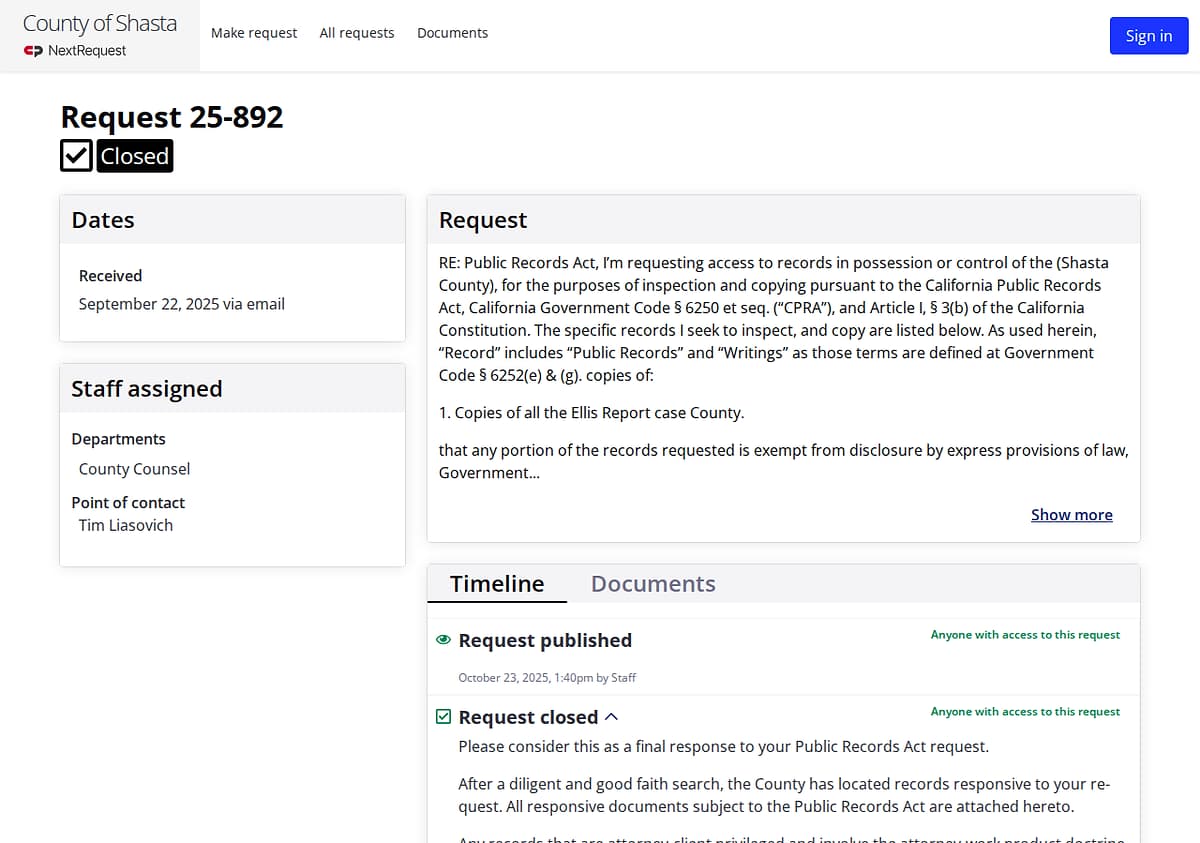
The full Ellis Report is public record, released through a California Public Records Act request. It can be reviewed directly at Shasta County's records portal.